

The Future of Cell-based Assays Market
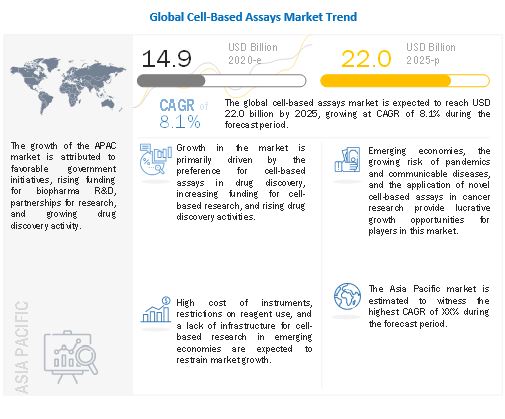
Cell-based assays are key components in the drug development process. Cell-based assays have several advantages over in vitro biochemical assays. They offer consistent tissue-specific responses in a biologically relevant microenvironment as opposed to biochemical assays. It is also not possible to prepare or purify every target for biochemical measurement, which is a major factor limiting the applications of biochemical assays.
As a result, pharmaceutical & biotechnology companies as well as CROs are replacing biochemical assays with cell-based assays for their lead identification and optimization processes in drug discovery.
The conventional methods of toxicity and drug safety assessment (involving animal testing) are expensive, time-consuming, and offer low-throughput. In this regard, modern cell-based assays merge the advantages of cell cultures and animal models to allow researchers to identify problems with lead compounds in early screening, ensuring greater efficiency in the drug discovery and development process.
Download PDF Brochure @ https://www.marketsandmarkets.com/pdfdownloadNew.asp?id=119917269
The growth of the reagents market is restricted by a different factor—product end-user licenses restrict the use of reagent kits only to specified assays. Due to this, even though better and superior reagents are available in the market, customers are restricted to using only those reagents specified in the license agreement. This may act as a barrier to the growth of the cell-based assays market.
According to estimates from the World Bank, the R&D spending in emerging economies in Asia and RoW has surpassed that of North America and Europe. Additionally, the increasing number of pharmaceutical companies and CROs—key end-users of cell-based assays—in these countries is expected to offer potential growth opportunities for manufacturers of cell-based assays.
A number of Asian governments have increased their focus on life science research over the last few years. For instance, the Global Health Innovative Technology (GHIT) Fund is a public-private partnership in Japan that funds various R&D activities for drug discovery, which also includes the screening of compound libraries related to various infectious diseases. R&D spending for new drug development is a critical growth driver for the global cell-based assays market.
The cell-based assays market is geographically segmented into North America, Europe, Asia Pacific, and the Rest of the World (RoW). While North America dominated the market in 2019, Asia Pacific is expected to register the highest CAGR in the market during the forecast period.
Some of the prominent players in the cell-based assays market are Thermo Fisher Scientific, Inc. (US), Danaher Corporation (Beckman Coulter, Inc.) (US), Becton, Dickinson and Company (US), GE Healthcare (US), Merck KGaA (Germany), Lonza Group (Switzerland), PerkinElmer, Inc. (US), Charles River Laboratories, Inc. (US), Cell Signaling Technologies (US), Cisbio (US), Cell Biolabs, Inc. (US), and Promega Corporation (US).
24World Media does not take any responsibility of the information you see on this page. The content this page contains is from independent third-party content provider. If you have any concerns regarding the content, please free to write us here: contact@24worldmedia.com