

A Deep Dive into Training and Technology
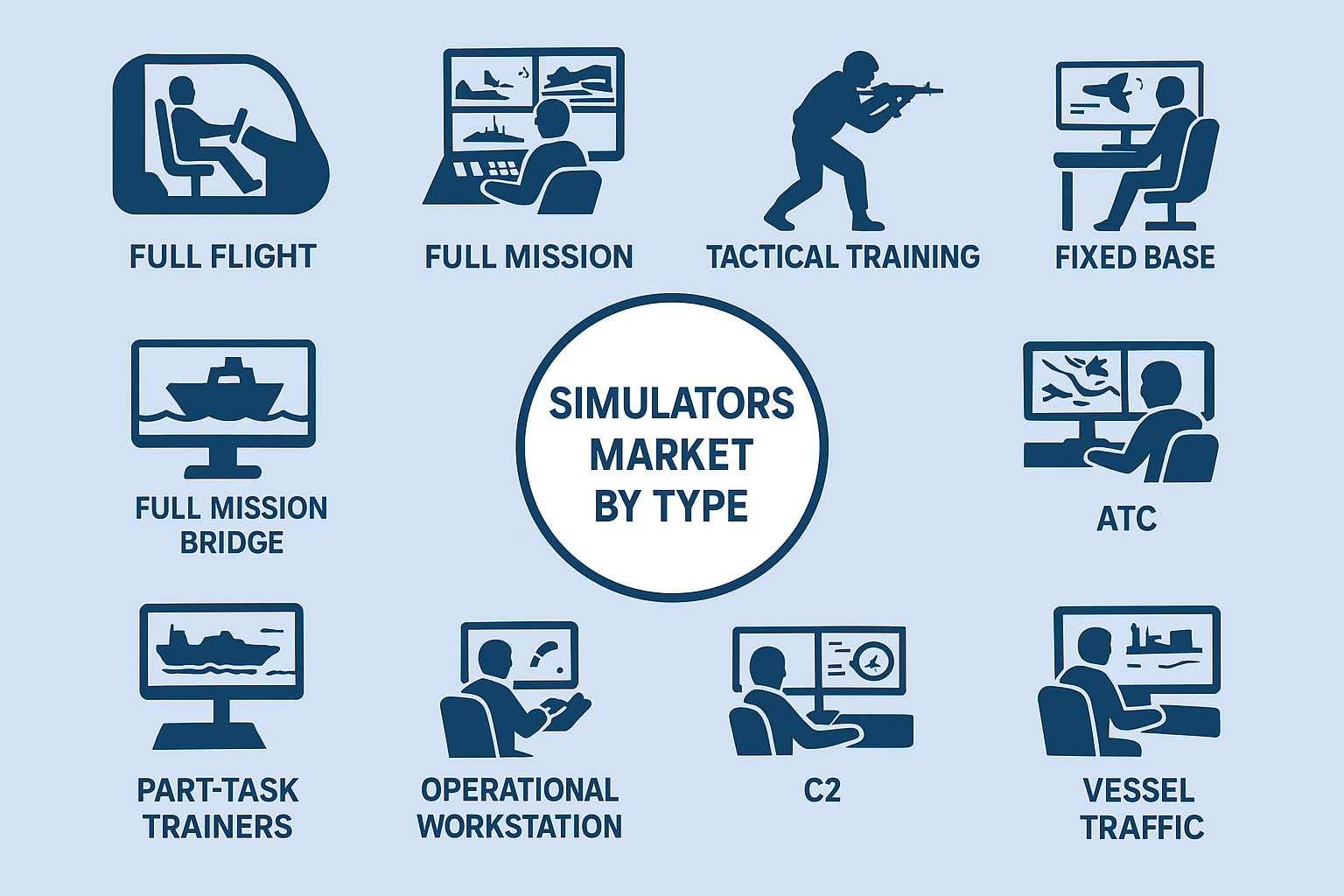
The simulators market has evolved into one of the most crucial segments of the global training and defense industry. From aviation to maritime, and from ground forces to command and control environments, simulation technologies have become indispensable tools that reduce costs, improve safety, and deliver highly effective training solutions. Over the years, the market has expanded across both civil and military applications, driven by rising demand for advanced skill development, adherence to strict safety regulations, and the integration of cutting edge digital technologies such as artificial intelligence, augmented reality, and machine learning.
As global industries face increasingly complex challenges, the reliance on simulators is growing rapidly. Airlines need highly trained pilots for new generation aircraft, defense organizations demand realistic combat preparation, and maritime operators require skilled navigators for safe vessel handling. Simulation technology offers these stakeholders a safe, cost effective, and immersive environment to enhance competencies without exposing assets or personnel to risk. This blog explores the simulators market by type, including full flight simulators, full mission systems, tactical training devices, fixed base simulators, full mission bridge simulators, part task trainers, operational workstation simulators, C2 systems, ATC simulators, and vessel traffic control systems.
Full Flight Simulators in Aviation Training
Full flight simulators represent the backbone of the aviation training industry. These advanced systems replicate the exact cockpit environment of an aircraft, complete with motion platforms, visual systems, and audio cues that immerse pilots in a realistic flying experience. Regulatory bodies such as the FAA, EASA, and ICAO mandate the use of full flight simulators for pilot licensing and recurrent training, making them a non negotiable investment for airlines and flight academies.
The surge in global air travel and fleet expansion, especially in emerging regions like Asia Pacific and the Middle East, is driving demand for new pilots. As airlines continue to grow, the shortage of skilled flight crews has intensified, thereby creating an unprecedented need for simulator based training. Full flight simulators not only reduce risks associated with live aircraft training but also offer immense cost savings, as training hours can be achieved without fuel consumption or aircraft wear and tear.
Technological advancements are enhancing the realism of these simulators through the integration of AI, virtual reality, and advanced motion cueing. Simulators are also being upgraded to replicate the performance of next generation aircraft such as the Boeing 787 and Airbus A350. As sustainability becomes a key concern, simulators are increasingly recognized as environmentally friendly alternatives to live training, further strengthening their importance in the aviation sector.
Full Mission Simulators in Defense and Military
Full mission simulators are extensively used in the defense sector to prepare armed forces for complex combat operations. Unlike traditional training methods, these simulators provide immersive environments that replicate realistic battlefield conditions. Military organizations rely on them for mission rehearsal, tactics development, and training across air, land, and naval domains.
The integration of full mission simulators with advanced technologies allows for high fidelity combat scenarios, including urban warfare, joint operations, and coalition missions. They are particularly valued for enabling soldiers and officers to practice in hazardous situations without exposing them to real world risks. AI integration further elevates their utility by generating adaptive threat environments and simulating unpredictable adversarial tactics.
Defense budgets across major economies such as the United States, China, and European nations are fueling investments in full mission simulation systems. Governments are prioritizing cost efficient training solutions that maximize combat readiness while reducing expenses associated with live operations. With global tensions rising, defense organizations increasingly view full mission simulators as strategic assets that enhance preparedness for both conventional and hybrid warfare scenarios.
Tactical Training Simulators
Tactical training simulators are focused on preparing infantry and ground forces for real world combat situations. They replicate scenarios such as urban warfare, counter terrorism operations, and homeland security missions. By simulating these high stakes environments, tactical simulators enhance soldier survivability and effectiveness while minimizing reliance on live fire exercises.
Portable tactical simulators are gaining traction because they can be deployed directly in the field for on the spot training. These systems often feature multi soldier networking, enabling collective exercises that simulate coordinated team maneuvers. AI based adaptive training systems further personalize scenarios to challenge trainees and refine their tactical decision making skills.
The increasing frequency of geopolitical conflicts and the growing need for homeland security are pushing governments to invest heavily in tactical simulation systems. As asymmetric warfare becomes more prevalent, the demand for flexible and advanced tactical training platforms continues to accelerate.
Fixed Base Simulators and Part-Task Trainers
Fixed base simulators and part task trainers are cost effective alternatives to full motion simulators. They are widely used in flight schools, regional airlines, and training academies for procedural practice, cockpit familiarization, and technical system handling. These simulators focus on skill refinement rather than motion replication, making them valuable for recurrent training programs and specific system mastery.
Part task trainers, in particular, are designed to replicate specific subsystems of an aircraft or vehicle, such as navigation systems, engine controls, or avionics. They provide modular and highly specialized training at a fraction of the cost of full mission simulators. By bridging the gap between theoretical instruction and advanced mission simulation, these devices are critical in optimizing pilot and operator readiness.
With the rapid expansion of regional aviation markets, especially in Asia and Africa, fixed base simulators and part task trainers are expected to see robust demand growth. Their affordability and flexibility make them indispensable tools in the broader training ecosystem.
Full Mission Bridge Simulators in Maritime Training
Maritime operations, both commercial and defense related, are highly dependent on skilled navigators and ship operators. Full mission bridge simulators play a vital role in training maritime personnel by replicating the conditions of ship bridges, including navigation, docking, and maneuvering in challenging environments. These simulators adhere to IMO and STCW regulations, ensuring compliance with global maritime training standards.
The demand for maritime safety and risk management has increased significantly as global trade volumes surge. Full mission bridge simulators are capable of replicating different ship classes, sea states, and weather conditions, making them essential for both naval operations and commercial shipping companies.
Naval forces also rely on these simulators for tactical maritime operations such as convoy escort, anti submarine warfare, and coastal defense. With the growth of offshore oil and gas activities, full mission bridge simulators are expanding into industrial training applications, ensuring safe operations in increasingly complex maritime environments.
Operational Workstation Simulators
Operational workstation simulators are specialized systems designed for command, planning, and operational decision making. These simulators are widely used in control centers, mission planning units, and emergency management organizations. Their primary function is to provide a realistic environment where decision makers can practice responding to complex scenarios.
They are particularly relevant for crisis response, homeland security, and disaster management, where rapid and accurate decision making is critical. AI integration has enhanced these systems, enabling real time decision support and scenario modeling. Cybersecurity and cyber defense simulations also benefit from operational workstation simulators, as they train personnel in managing sophisticated digital threats.
As non combat staff become increasingly essential in both civil and defense operations, the demand for operational workstation simulators is expected to rise significantly. These systems also play a growing role in civilian emergency services, ensuring coordinated responses to natural disasters, pandemics, and other large scale emergencies.
C2 (Command and Control) Simulators
C2 simulators are integral to modernizing defense command structures and preparing leaders for high pressure decision making. These simulators replicate command level scenarios that require situational awareness, resource management, and coordination across multiple units.
The integration of C2 simulators with tactical and mission simulation systems ensures interoperability and seamless training across domains. AI driven environments further enhance their relevance by replicating rapidly evolving threat landscapes. They are particularly valuable for joint operations and multinational coalition training, where coordination across different forces is essential.
As cyber warfare and electronic warfare become increasingly important, C2 simulators are being adapted to train command personnel in these specialized domains. They also support the transition toward autonomous defense systems, offering a future ready training platform for military leadership.
ATC (Air Traffic Control) Simulators
Air traffic control simulators are essential for ensuring the safety and efficiency of global airspace. With air passenger traffic continuing to rise, training air traffic controllers is more critical than ever. These simulators provide realistic environments for tower, radar, and en route traffic management training.
Regulatory requirements from ICAO and FAA have accelerated the adoption of ATC simulators. They prepare controllers to handle complex traffic scenarios, emergency situations, and weather disruptions. AI driven features enable predictive traffic management, further enhancing safety and efficiency.
The growing number of airports, especially in emerging economies, has fueled demand for ATC training systems. Civil military integrated ATC systems are also expanding as airspaces become more congested and require joint oversight. With airport expansion projects on the rise, ATC simulators will continue to play a pivotal role in global aviation infrastructure.
Vessel Traffic Simulators and Maritime Control
Vessel traffic simulators are crucial for managing congested waterways, ports, and harbors. They train vessel traffic service operators to monitor, coordinate, and guide maritime traffic safely. By replicating real world navigation scenarios, these simulators help reduce collision risks and improve maritime safety.
Integration with full mission bridge simulators enhances their utility, enabling coordinated training between ship crews and traffic control operators. With global trade volumes increasing and smart port initiatives gaining traction, vessel traffic simulators are becoming indispensable for port authorities and shipping companies.
In the defense sector, these simulators support coastal surveillance and maritime security operations. AI driven vessel tracking and predictive analytics are enhancing their capabilities, aligning them with the future of autonomous shipping and smart maritime logistics.
Future Outlook of the Simulators Market
The simulators market is set to grow exponentially as industries prioritize safety, cost efficiency, and skill development. Technological advancements such as AI, VR, AR, and machine learning are pushing the boundaries of simulation realism and effectiveness. Defense modernization programs, aviation expansion, maritime safety requirements, and homeland security needs are collectively driving adoption across multiple sectors.
As simulators become more interoperable and capable of integrating multiple domains, they will play a central role in global training and preparedness strategies. The future of the simulators market lies in creating flexible, scalable, and intelligent systems that adapt to evolving threats, operational complexities, and technological progress.
24World Media does not take any responsibility of the information you see on this page. The content this page contains is from independent third-party content provider. If you have any concerns regarding the content, please free to write us here: contact@24worldmedia.com