

Lead Acid Battery Market to Surge Considerably; Significant Rise in Data Centers Across Glob to Fuel Market Growth
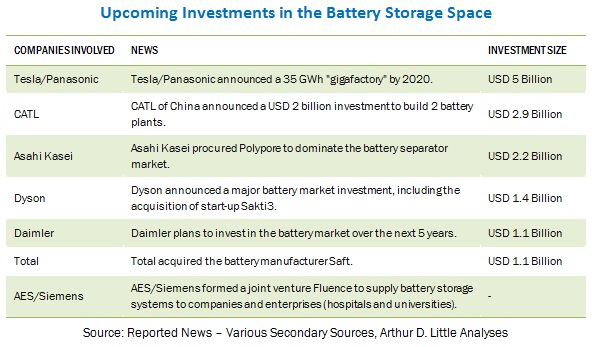
The global lead acid battery market is expected to grow from an estimated USD 41.6 billion in 2019 to USD 52.5 billion by 2024, at a CAGR of 4.7% during the forecast period. The growth of this market is driven by burgeoning expansion in the automotive industry, rapid technological advancement, development of the telecom sector, and the cost-effectiveness of lead acid battery storage solution.
Market Ecosystem
The global lead acid battery market is dominated by a few major players that have an extensive regional presence. The leading players in the lead acid battery market are EnerSys (US), Exide Industries (India), GS Yuasa (China), Clarios (US), Panasonic (Japan), Chaowei Power (China), Narada Power (China), HBL Power Systems (India), Crown Battery (US), NorthStar (Sweden), Hitachi Chemical (Japan), Exide Technologies (US), Teledyne Technologies (US), East Penn (US), Hankook AltasBX (Korea), HOPPECKE (Germany), C&D Technologies (US), Rolls Battery (Canada), Camel Power (Malaysia), Amara Raja Power System (India), XUPAI Battery (China), Okaya Power (India), Leoch International Technology (Hong Kong), Harbin Coslight Power (China), and First National Battery (South Africa).
The major strategies adopted by the players include new product launches, investments & expansions, mergers & acquisitions, contracts & agreements, partnerships, alliances, joint ventures, and collaborations. Contracts & agreements was the most commonly adopted strategy from February 2016 to February 2019. These industry players also adopted new product launches and mergers & acquisitions as major strategies during that period.
Speak to Analyst: https://www.marketsandmarkets.com/speaktoanalystNew.asp?id=161171997
This research report categorizes the lead acid
battery market based on technology, type, construction method, end-user,
industrial, and region
By Technology
- Basic Lead Acid Battery
- Advanced Lead Acid battery
By Type
By Construction Method
- Flooded
- Valve Regulated Lead Acid (VRLA)
By End-user
- Utility
- Transportation
- Industrial
- Commercial & Residential
By Industrial
- Data Centers
- Telecom
- Oil & Gas
- Others
By Region
- Asia Pacific (China, Japan, India, South Korea, Rest of APAC)
- North America (US, Canada, Mexico)
- Europe (Germany, UK, Italy, Russia, Rest of Europe)
- Middle East & Africa UAE, Saudi Arabia, South Africa, Rest of the Middle East & Africa)
- South America (Brazil, Columbia, Rest of South America)
Restraint: Low-cost alternatives in energy storage space
Until recently, lead-acid batteries have been the
most cost-effective technology. However, with the rise of alternative
battery storage technologies, especially the lithium-ion technology,
lead-acid batteries are losing out on the cost-effectiveness quotient.
Lead-acid batteries are witnessing a price drop nearly across all
industries. Simultaneously, the Nickel-Metal Hydride (NiMH) battery is a
proven and mature technology for hybrid applications. It is used by
Original Equipment Manufacturers (OEMs), including Toyota, Honda, and
Lexus. The OEMs prefer these batteries for their safety, performance,
and longer lifecycle in hybrid applications. Also, along with NiMH
batteries, even nickel-cadmium batteries prove to be a cost-efficient
solution for battery storage users. They are cheaper and more effective
as an alternative to lead-acid batteries.
Opportunity: Expanding data center infrastructure
Massive demand for battery storage is found in data
centers. Any power disruptions and inconsistencies in data centers may
prove crucial. Thus, lead-acid batteries mostly cater to the backup
power needs of this particular industry. Also, the UPS used in the
industry are primarily lead-acid battery systems. Therefore, a
significant amount of this category of batteries is used in this
industry.
In the near future, significant demand is foreseen for the installation of data centers. With the growing generation of data, the data handling capacity is also expected to increase in the years to come. As data centers use lead-acid batteries, their demand is consequently bound to increase.
Ask for FREE Sample Pages: https://www.marketsandmarkets.com/requestsampleNew.asp?id=161171997
Limited usage capacity of lead-acid batteries
Lead-acid batteries are expected to have a low
useable capacity. It is typically taken into consideration to use just
30–50% of the rated capacity of a typical lead-acid battery. This
indicates that a 600 Ah battery bank in daily practice provides only, at
the maximum, 300 Ah of actual capacity. If one even occasionally drains
the batteries more than this, their life would drastically reduce.
Also, these batteries waste energy and have major efficiency issues.
They consume as much as 15% of the energy put into them via built-in
charging, indicating inefficiency. Hence, if one supplies 100 A power,
one would only be storing just 85 Ah. This can be frustrating when using
the solar mode of charging when one is trying to squeeze as much
efficiency out of every ampere as possible before sunset or gets covered
up by clouds.
24World Media does not take any responsibility of the information you see on this page. The content this page contains is from independent third-party content provider. If you have any concerns regarding the content, please free to write us here: contact@24worldmedia.com