

Sustainability update: Consumer trends and business developments brands need to know about

In this series, Global Outlook on Sustainability author Richard Cope explores how Mintel’s sustainability research relates to government issues, business issues, the sustainability roles and responsibilities of consumer-facing brands, and current popular culture.
Nature. Is. Amazing.

Consumers prioritise conservation, but in an increasingly urbanised and digitised society, how do we get people to value and connect with nature and its benefits?
In May, a video of New York Yankees fans marvelling as a squirrel enlivened a baseball game went viral, provoking much mirth and comment. Twitter respondent nycpitt’s question encapsulated the pervading sentiment: “These people ever seen a squirrel before?”
Climate change is driving migration. The World Bank reports that 216 million people will move within their countries by 2050—mostly to the cities. As the world urbanises (three million people already move into cities every week, according to the UN), two scenarios are developing.
One is that, as cities expand into natural habitats, we are alarmed by coming into closer contact with bats and rodents, which are responsible for 60% of the diseases transmitted from animals to humans, according to the UNDRR.
The other is that our city-slicker status further distances us from nature, compounding a situation where just 23% of us grow our own food in a garden or outdoor space such as a balcony. This rural/urban divide will also make it increasingly difficult for companies to ground their assertions around achieving carbon neutrality through forestation programmes in far-off locations.
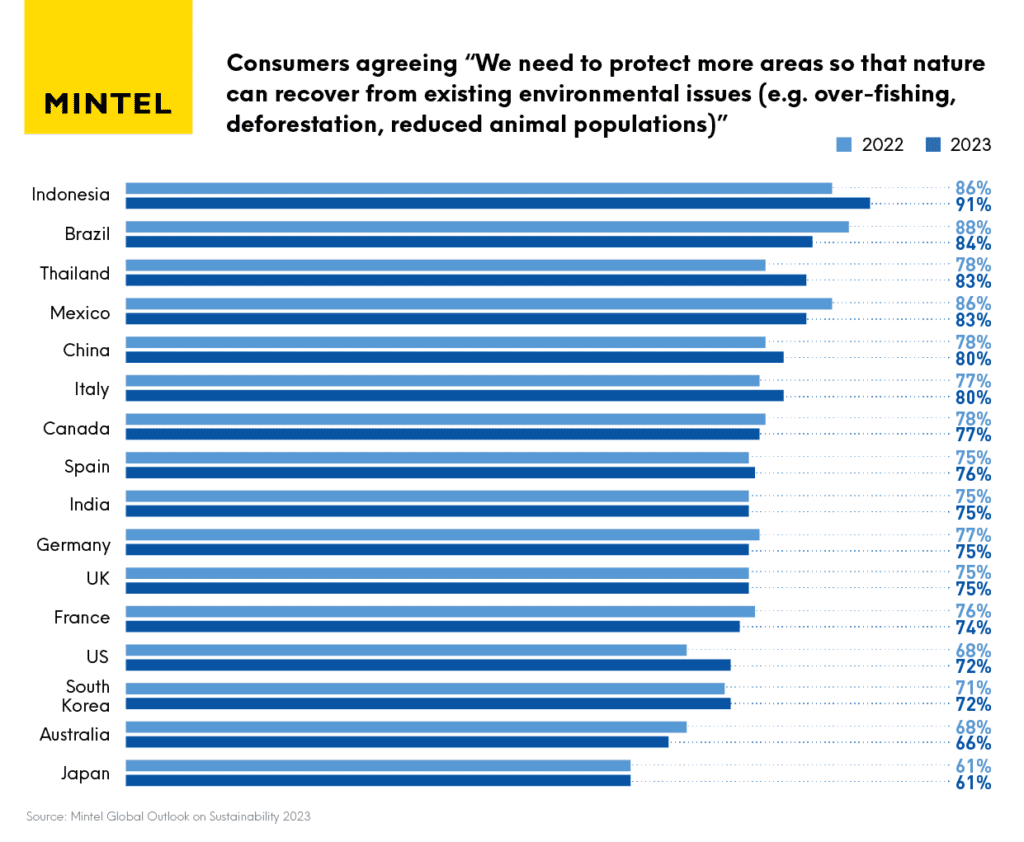
This is because, whilst 76% of consumers agree “we need to protect more areas so that nature can recover from existing environmental issues” (eg over-fishing, deforestation, reduced animal populations), just 66% say they “would prefer for companies to reduce their carbon emissions rather than use ‘Carbon Offsetting’ programmes outside of their area of business”.
Conservation is clearly something that we need to do (the WWF’s Living Planet Report 2022 reveals a 69% decline (on average) in monitored wildlife populations around the world between 1970 and 2018), yet, these measures and investments might be better suited to governments and multinationals than consumer-facing businesses.
The fact that consumer interest in conservation cools at the slightest sound of jargon—just 17% cite “loss of biodiversity on land” as one of their top three environmental concerns—emphasises how terminology, as much as geography, needs to be tangible to land with people.
One option is to sell in nature as a healthy city break—or in-city staycation—perhaps as Destination Canada has done by having doctors prescribe park passes because of the positive impact the outdoors has on physical and mental wellbeing.
Another is to leverage localism. The good news is that cities create communities with the capability to play upon neighbourhood provenance—be that through rewilding, urban farming or craft brewing. Here, natural benefits and the conservation and maximisation of local resources can hit home.
Initiatives like Cycloponics’ underground chicory and mushroom farm in Paris show what can be done with urban resources. The localised appeal of the Denver Beer Co is even broader, as it converts ‘local’ solar energy from 258kW worth of rooftop panels and captures 100,000lbs of CO2 onsite for use as a raw material at the nearby cannabis company, The Clinic.
Cities can become their own closed loops, but nature and its processes need to be re-incorporated into their fabric. For consumers, conservation—like charity—begins at home.
‘We the people’: Eco-litigation in the US and beyond
Let’s take a look at how the mobilisation and momentum around climate change litigation are creating an emerging compliance issue for consumer-facing businesses.
Earlier this month, sixteen young plaintiffs, aged 5-to-22, took to the US legal system to challenge the state of Montana’s fossil fuel-friendly policies on the basis that they contravene the state’s constitution and its commitment to “maintain and improve a clean and healthful environment in Montana for present and future generations”.
This is not an isolated case. We’re seeing a new generation of legal professionals who are starting to hold governments and businesses accountable to their electorates, shareholders, employees and customers on environmental grounds.
ClientEarth, for example, is a global team of lawyers seeking to ensure governments and companies are held accountable for damages and for upholding the Paris Agreements. The organization has successfully closed Poland’s Belchatów coal-fired power station because it contravened the owner’s obligation, according to Polish law, to take care of the public interest and public health.

These are the latest episodes in an ongoing global legal drama that signposts how the line between corporate and governmental responsibility is blurring, whilst both parties are being challenged to do right by their respective customers, shareholders and electorates.
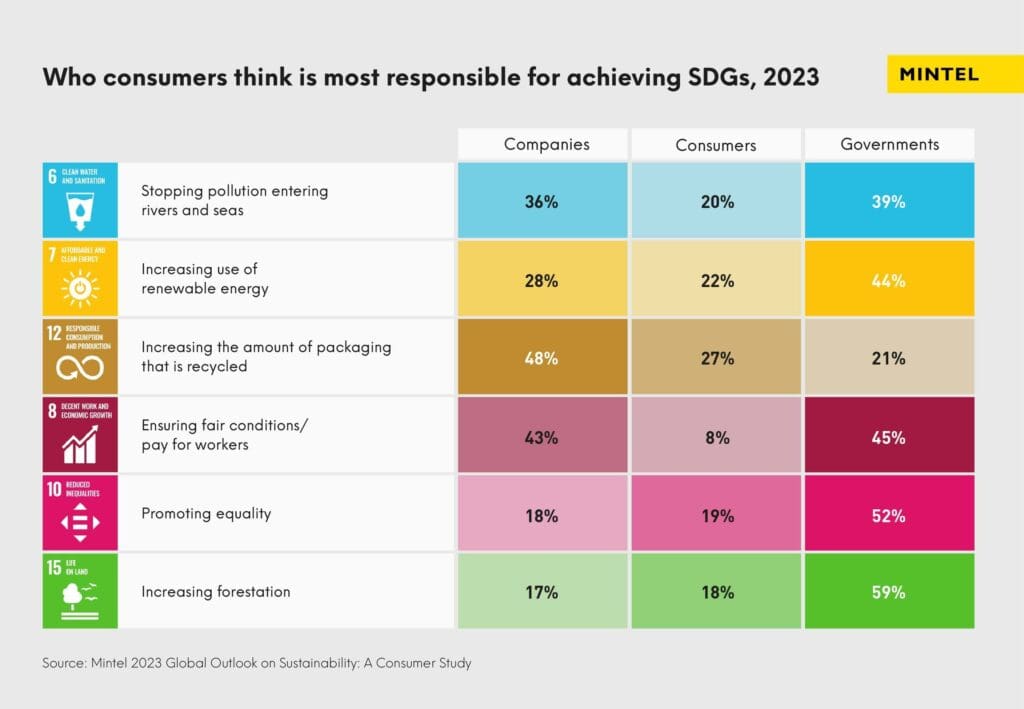
Data from Mintel’s Global Outlook on Sustainability report illustrates this point at a global level (see chart). Digging deeper into the US data, we see that growing numbers of Americans believe the government is most responsible for reducing the use of fossil fuels for energy (36%, up three points in the last 12 months), whilst 35% say companies are most responsible for increasing renewable energy usage. The fact that similar proportions agree that eco-activism is “a legitimate form of protest” and that it “has raised my awareness of environmental issues” suggests how burgeoning awareness will grow the eco-litigation trend.
Compliance and avoiding punitive costs are classic components amongst the key arguments in the business case for companies to transition towards sustainability. However, it seems that companies have the most to fear. After all, initiatives like The Carbon Disclosure Project’s (CDP) Carbon Majors Database have revealed that, since 1988, just 50 companies have been responsible for three-quarters of greenhouse gas emissions from oil and gas.
Companies are about to find out that their responsibilities will no longer be confined to their shareholders and their levels of contentment but to a broader community of stakeholders who are impacted by those products and policies.
Mintel’s ‘Global Outlook on Sustainability: A Consumer Study’ was developed to help businesses lead effective change that resonates with and inspires consumers. The report tracks the environmental and social priorities, purchase behaviours, and levels of understanding of and engagement in sustainability topics among consumers from 16 countries. With the ever-increasing conversation around climate change and environmental concerns, now’s the time to get informed. Take advantage of this opportunity to focus your business goals on sustainability and improve your brand’s future viability and buy the report today.
24World Media does not take any responsibility of the information you see on this page. The content this page contains is from independent third-party content provider. If you have any concerns regarding the content, please free to write us here: contact@24worldmedia.com