

The Future of Autonomous Air Defense Technologies
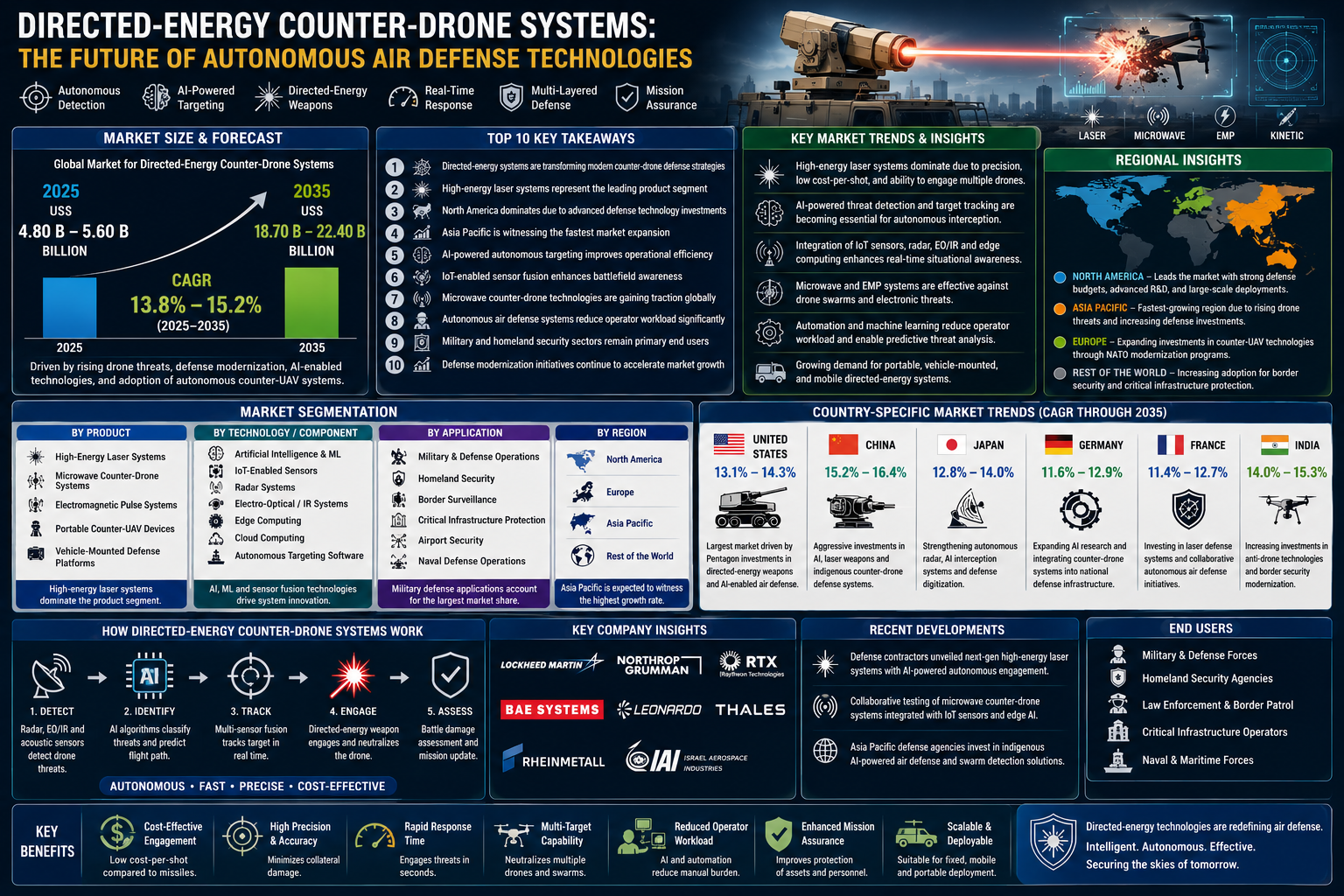
Directed-Energy Counter-Drone Systems: The Future of Autonomous Air Defense Technologies Summary
The global market for directed-energy counter-drone systems is projected to grow from US$ 4.80 Billion – US$ 5.60 Billion in 2025 to US$ 18.70 Billion – US$ 22.40 Billion by 2035 at a CAGR of 13.8% – 15.2% from 2025 to 2035. The rapid proliferation of unmanned aerial vehicles (UAVs), increasing asymmetric warfare threats, and rising concerns over unauthorized drone intrusions are accelerating demand for advanced autonomous air defense technologies. Governments and defense agencies are increasingly deploying directed-energy weapons such as high-energy lasers, microwave systems, and electromagnetic countermeasures to neutralize hostile drones efficiently and cost-effectively. The integration of artificial intelligence, IoT-enabled sensor networks, automated threat detection platforms, and real-time battlefield analytics is transforming the next generation of air defense systems. Digital transformation initiatives across global defense sectors, combined with advancements in autonomous targeting, edge computing, and AI-driven command-and-control systems, are expected to significantly drive market growth during the forecast period.
Key Market Trends & Insights
North America currently leads the market due to substantial investments in advanced air defense systems, directed-energy weapons research, and military modernization programs.
Asia Pacific is expected to emerge as the fastest-growing region as countries including China, India, Japan, and South Korea expand defense spending and strengthen anti-drone defense infrastructure.
High-energy laser systems dominate the market because of their precision targeting capabilities, low operational costs, and ability to engage multiple aerial threats rapidly.
AI-powered autonomous threat detection and target tracking technologies are becoming essential components of modern counter-drone defense systems.
Military organizations are increasingly integrating IoT-connected radar, electro-optical sensors, and edge computing systems to enhance real-time situational awareness.
Automation and machine learning are reducing operator workload by enabling faster target identification, autonomous interception, and predictive threat analysis.
Download PDF Brochure: https://www.marketsandmarkets.com/pdfdownloadNew.asp?id=4197284
Market Size & Forecast
- Base year market size (2025): US$ 4.80 Billion – US$ 5.60 Billion
- Forecast value by 2035: US$ 18.70 Billion – US$ 22.40 Billion
- CAGR (2025–2035): 13.8% – 15.2%
- Market growth is driven by rising drone threats, defense modernization programs, AI-enabled air defense technologies, and increased adoption of autonomous counter-UAV systems
Directed-Energy Counter-Drone Systems: The Future of Autonomous Air Defense Technologies Top 10 key takeaway
- Directed-energy systems are transforming modern counter-drone defense strategies
- High-energy laser systems represent the leading product segment
- North America dominates due to advanced defense technology investments
- Asia Pacific is witnessing the fastest market expansion
- AI-powered autonomous targeting improves operational efficiency
- IoT-enabled sensor fusion enhances battlefield awareness
- Microwave counter-drone technologies are gaining traction globally
- Autonomous air defense systems reduce operator workload significantly
- Military and homeland security sectors remain primary end users
- Defense modernization initiatives continue to accelerate market growth
Product Insights
High-energy laser systems currently dominate the directed-energy counter-drone systems market due to their ability to engage aerial threats with exceptional speed, precision, and minimal collateral damage. These systems are increasingly favored by military organizations because they offer lower operational costs compared to traditional missile-based defense systems while enabling rapid interception of multiple drone threats.
Microwave-based counter-drone systems are emerging as a fast-growing segment due to their effectiveness against drone swarms and electronic systems. High-power microwave weapons can disable multiple UAVs simultaneously by disrupting onboard electronics and communication systems. This capability is becoming increasingly valuable as autonomous drone swarm technologies evolve.
Portable counter-drone systems and vehicle-mounted directed-energy platforms are also witnessing strong demand for border security, military base protection, and critical infrastructure defense applications. Defense agencies are focusing on compact, mobile, and rapidly deployable systems capable of operating in diverse combat environments.
Artificial intelligence integration is playing a major role in enhancing system performance. AI-powered targeting algorithms enable faster drone detection, automated classification, predictive trajectory analysis, and autonomous threat neutralization, significantly improving overall operational effectiveness.
Technology / Component Insights (Rename based on keyword if needed)
Artificial intelligence, machine learning, computer vision, and sensor fusion technologies are driving innovation across the directed-energy counter-drone systems market. AI algorithms enable autonomous threat assessment, real-time drone identification, and adaptive targeting capabilities, helping defense operators respond more effectively to evolving aerial threats.
IoT-enabled radar systems, electro-optical sensors, infrared tracking systems, and acoustic detection technologies are increasingly being integrated into autonomous air defense platforms. These interconnected sensor networks create highly responsive battlefield awareness ecosystems capable of tracking drones across complex operational environments.
Edge computing technologies are enhancing system responsiveness by enabling localized processing of critical battlefield data without dependence on centralized communication networks. This capability is particularly important in contested military environments where communication disruptions may occur.
Cloud-based defense analytics platforms are helping military organizations collect, process, and analyze operational data to improve threat intelligence and system optimization. Automation technologies are also enabling predictive maintenance, system diagnostics, and operational readiness monitoring.
Future innovations are expected to include AI-driven autonomous engagement systems, quantum-enhanced radar technologies, directed-energy drone swarm defense solutions, and next-generation multi-layered autonomous air defense architectures.
Application Insights
Military and defense applications account for the largest share of the directed-energy counter-drone systems market. Armed forces globally are deploying autonomous air defense systems to protect military bases, forward operating locations, naval fleets, armored formations, and critical battlefield assets from hostile UAV threats.
Homeland security and border protection applications are also experiencing rapid growth due to increasing concerns regarding unauthorized drone activity near airports, government buildings, and strategic infrastructure. Directed-energy counter-drone technologies provide law enforcement agencies with scalable and non-kinetic defense capabilities.
Critical infrastructure protection represents another major application segment. Energy facilities, transportation hubs, industrial sites, and communication networks are increasingly adopting autonomous drone defense systems to mitigate potential security threats.
Future opportunities are expected to emerge in civilian airspace management, smart city security systems, and commercial infrastructure protection as regulatory frameworks surrounding drone operations continue to evolve globally.
Regional Insights
North America remains the dominant market for directed-energy counter-drone systems due to strong defense budgets, advanced military R&D capabilities, and large-scale deployment of autonomous defense technologies across the United States. The region is witnessing increasing adoption of AI-powered air defense systems and next-generation laser weapon platforms.
Europe is steadily expanding its market presence through NATO-supported defense modernization programs and increasing investments in counter-UAV technologies. Countries such as the United Kingdom, Germany, and France are accelerating the development of integrated autonomous air defense systems.
Asia Pacific is expected to register the fastest growth due to rising geopolitical tensions, increasing drone warfare threats, and aggressive military modernization initiatives across China, India, Japan, and South Korea. Regional governments are prioritizing indigenous defense manufacturing and AI-enabled air defense technologies.
Middle Eastern countries are also increasing investments in directed-energy systems to strengthen critical infrastructure security and counter evolving drone threats in conflict-prone environments.
- North America leads the market through advanced defense modernization programs
- Asia Pacific is the fastest-growing regional market
- Europe is increasing investments in autonomous counter-drone technologies
- AI-powered laser systems are gaining strong adoption globally
- Critical infrastructure protection is driving regional market demand
[Country]-Specific Market Trends
China is expected to witness a CAGR of approximately 15.2% – 16.4% due to large-scale investments in military AI systems, drone defense technologies, and indigenous laser weapon programs. Japan is focusing on strengthening autonomous air defense capabilities through advanced radar integration and AI-enabled interception systems.
The United States remains the largest market globally with a CAGR of approximately 13.1% – 14.3%, supported by extensive Pentagon investments in directed-energy weapons, autonomous defense systems, and AI-powered threat detection technologies. Canada is increasing investments in border surveillance automation, while Mexico is strengthening infrastructure security capabilities.
Germany and France are expanding defense AI research programs and integrating autonomous counter-drone systems into national security infrastructure. European governments are also supporting collaborative air defense modernization initiatives through NATO partnerships.
- China is aggressively expanding AI-enabled directed-energy defense programs
- Japan is strengthening autonomous radar and interception systems
- The United States continues to dominate global defense AI investments
- Germany and France are accelerating counter-UAV modernization efforts
- Government-supported defense innovation programs are driving long-term growth
Key Directed-Energy Counter-Drone Systems: The Future of Autonomous Air Defense Technologies Company Insights
Leading companies operating in the directed-energy counter-drone systems market include Lockheed Martin, Northrop Grumman, Raytheon Technologies, BAE Systems, Leonardo S.p.A., Thales Group, Rheinmetall, and Israel Aerospace Industries.
These companies are heavily investing in AI-enabled autonomous targeting systems, high-energy laser weapons, microwave defense technologies, and integrated battlefield analytics platforms. Strategic partnerships with government defense agencies and AI software developers are accelerating innovation and commercialization efforts.
Industry participants are also prioritizing scalable modular systems, autonomous threat detection algorithms, and multi-domain defense integration capabilities to strengthen competitive positioning in the rapidly evolving counter-drone defense market.
- Defense firms are prioritizing AI-enabled autonomous targeting technologies
- High-energy laser weapon development remains a major strategic focus
- Partnerships with defense agencies are accelerating innovation
- Companies are investing in scalable modular defense architectures
- Autonomous air defense integration is driving long-term competitiveness
Recent Developments
Several defense contractors recently unveiled next-generation high-energy laser systems capable of autonomously identifying and neutralizing multiple drone threats simultaneously using AI-powered targeting software.
Military organizations across North America and Europe initiated collaborative testing programs for autonomous microwave-based counter-drone platforms integrated with IoT-enabled sensor networks and edge computing capabilities.
Defense agencies in Asia Pacific are increasingly partnering with domestic technology firms to develop indigenous AI-powered air defense systems focused on swarm drone detection and autonomous battlefield protection.
Market Segmentation
The directed-energy counter-drone systems market is segmented by product, technology/component, application, and region. By product, the market includes high-energy laser systems, microwave counter-drone systems, electromagnetic pulse systems, portable counter-UAV devices, and vehicle-mounted defense platforms. High-energy laser systems currently dominate due to their precision and operational efficiency.
By technology/component, the market includes artificial intelligence, machine learning, IoT-enabled sensors, radar systems, electro-optical tracking systems, cloud computing, edge computing, and autonomous targeting software.
Applications include military and defense operations, homeland security, border surveillance, critical infrastructure protection, airport security, and naval defense operations. Military applications account for the largest market share due to growing battlefield drone threats.
Regionally, the market is segmented into North America, Europe, Asia Pacific, and the rest of the world. North America currently dominates, while Asia Pacific is expected to witness the highest growth during the forecast period.
- High-energy laser systems lead the product segment
- AI and machine learning drive technology innovation
- Military defense applications dominate overall market demand
- Critical infrastructure protection is emerging rapidly
- Asia Pacific is expected to witness the strongest growth rate
Conclusion
Directed-energy counter-drone systems are rapidly emerging as a cornerstone of next-generation autonomous air defense technologies. As drone threats continue to evolve across military, homeland security, and critical infrastructure environments, governments and defense organizations are increasingly investing in AI-powered autonomous interception systems capable of delivering fast, precise, and cost-effective protection.
The integration of artificial intelligence, IoT-enabled battlefield networks, cloud analytics, and automation technologies is significantly enhancing operational efficiency, reducing response times, and enabling autonomous threat neutralization capabilities. These advancements are reshaping modern air defense architectures and strengthening multi-domain operational readiness.
The market is expected to witness robust growth through 2035, driven by rising geopolitical tensions, expanding drone warfare threats, and accelerating global defense modernization initiatives. Organizations investing in intelligent autonomous air defense systems, directed-energy weapons, and AI-enabled battlefield technologies are expected to gain significant strategic and operational advantages in the future defense landscape.
24World Media does not take any responsibility of the information you see on this page. The content this page contains is from independent third-party content provider. If you have any concerns regarding the content, please free to write us here: contact@24worldmedia.com