

UAV Battery Market: Lithium, Fuel Cell, Sodium
The global drone, or unmanned aerial vehicle (UAV), industry has witnessed remarkable growth in recent years, with applications expanding across defense, commercial, industrial, and recreational sectors. Central to the success of drones is the reliability and performance of their power sources, making batteries a critical component of UAV technology. The efficiency, endurance, safety, and cost effectiveness of drones are directly linked to advancements in battery technologies. As UAVs become more sophisticated, their power demands are also increasing, which has led to rapid innovation in the drone battery market.
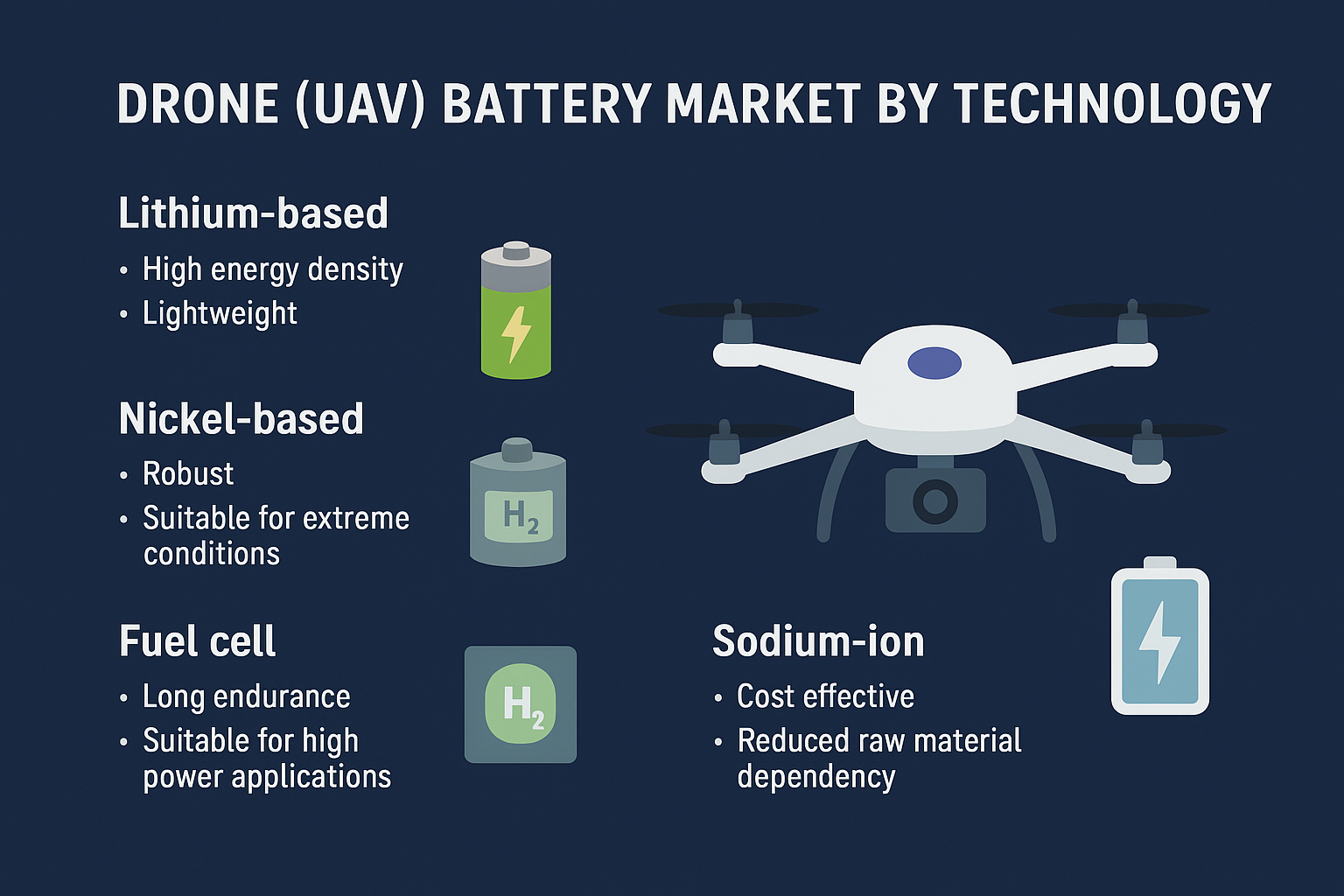
The market is dominated by four primary categories of battery technologies: lithium based, nickel based, fuel cell systems, and emerging sodium ion batteries. Each of these technologies comes with unique benefits, limitations, and levels of market adoption. While lithium ion and lithium polymer batteries are currently the most widely used due to their high energy density and lightweight characteristics, fuel cells are gaining traction for endurance UAVs, and sodium ion batteries are emerging as a promising cost efficient alternative. As artificial intelligence (AI) integrates into UAV battery management systems, the efficiency and safety of these power solutions are improving significantly. This blog explores the dynamics of the UAV battery market by technology, examining key trends, adoption patterns, regulations, and future outlook.
Lithium-Based Battery Technology in UAVs
Lithium based batteries dominate the UAV battery market, with lithium ion and lithium polymer variants being the most prevalent. These batteries are favored for their high energy density, lightweight design, and long recharge cycles, making them particularly suitable for drones requiring agility and extended flight times. The balance between power output and portability makes lithium based batteries the go to option for both commercial and defense drones.
Lithium polymer batteries, in particular, are popular for small to medium sized drones due to their compact form factor and flexible packaging. These batteries are also capable of delivering higher discharge rates, which is critical for drones involved in high performance applications such as aerial photography, racing, and military reconnaissance. Despite their dominance, lithium batteries are not without limitations. Safety concerns, particularly around thermal runaway and fire hazards, remain key challenges. The high cost of raw materials like lithium and cobalt also impacts scalability, pushing researchers to explore alternative solutions. Nonetheless, lithium based batteries will continue to lead the UAV battery market in the near future due to their proven efficiency and widespread availability.
Drone Battery Market
Nickel-Based Battery Technology in UAVs
Nickel based batteries, such as nickel metal hydride (NiMH) and nickel cadmium (NiCd), represent an older generation of battery technology that still finds niche applications in drones. Although nickel batteries are heavier and less energy dense compared to lithium based options, they are valued for their robustness and ability to function under extreme temperature conditions. These characteristics make them suitable for specialized drones operating in harsh environments.
NiMH batteries offer an environmentally safer alternative to NiCd batteries, which are restricted in many regions due to cadmium’s toxicity. The lower energy to weight ratio of nickel based batteries restricts their use in commercial UAVs that require long endurance or high power output. As the UAV industry evolves toward lighter and more energy efficient designs, nickel batteries are gradually losing relevance in mainstream applications. Their future role in the drone battery market is likely to remain limited to niche or legacy systems rather than large scale adoption.
Fuel Cell Technology for Drone Batteries
Fuel cells are emerging as a disruptive technology in the UAV battery market, offering significant advantages in endurance and operational efficiency. Hydrogen fuel cells, in particular, are gaining traction for long duration missions where traditional lithium ion batteries fall short. Unlike conventional batteries that store energy, fuel cells generate electricity continuously as long as hydrogen fuel is supplied. This results in significantly longer flight times, often exceeding several hours, compared to lithium ion systems that typically last less than one hour.
Fuel cell powered drones are particularly attractive for defense, surveillance, cargo delivery, and industrial inspection missions where long endurance is essential. The U.S. military and commercial players are investing heavily in hydrogen fuel cell drone development to extend mission capabilities. Fuel cell adoption faces challenges such as high costs, limited hydrogen infrastructure, and storage complexities. Despite these hurdles, the long term potential of fuel cell technology is immense, especially as hydrogen production becomes more sustainable through renewable energy.
Emerging Sodium-Ion Battery Technology for UAVs
Sodium ion batteries are an emerging alternative in the UAV battery market, promising cost effectiveness and reduced reliance on scarce raw materials like lithium and cobalt. Sodium is abundant and widely available, which could significantly reduce the production costs of UAV batteries. Sodium ion batteries offer better thermal stability compared to lithium ion batteries, reducing risks of overheating and fire hazards.
Sodium ion technology is still in its early stages of commercialization. Current prototypes exhibit lower energy density compared to lithium ion batteries, which limits their application in drones that demand high performance. Researchers are actively working to overcome these limitations, with recent breakthroughs showing promise for energy density improvements. If successfully scaled, sodium ion batteries could provide a sustainable and cost efficient alternative, particularly for low to mid range commercial drones where affordability and safety are prioritized.
AI Integration in UAV Battery Management Systems
Artificial intelligence is playing a transformative role in UAV battery management. AI enabled systems monitor battery health in real time, using predictive analytics to forecast potential issues such as overheating, overcharging, or capacity degradation. This not only improves safety but also extends battery life and ensures drones operate with maximum efficiency.
AI also optimizes charging cycles, ensuring batteries are recharged in ways that minimize wear and tear. For commercial fleets of drones, AI driven management systems allow operators to monitor multiple UAV batteries simultaneously, streamlining maintenance schedules and reducing operational downtime. In high stakes applications such as defense and disaster response, where drones cannot afford unexpected power failures, AI ensures reliability by predicting and preventing potential failures before they occur.
Market Dynamics and Demand Drivers
The UAV battery market is experiencing strong demand growth due to the expanding role of drones in multiple industries. In defense, drones are critical for reconnaissance, surveillance, and tactical missions, which require reliable and long endurance batteries. In commercial sectors, drones are being deployed for applications ranging from package delivery and agricultural monitoring to infrastructure inspection and environmental surveys. All these use cases demand batteries that provide higher energy density, longer flight times, and faster recharging capabilities.
The push for electrification and reduced emissions is also influencing UAV battery innovation. Traditional fossil fuel powered UAVs are being replaced by electrically powered alternatives to meet sustainability targets. The integration of advanced battery technologies is central to this transition. Cost efficiency, safety, and durability are further shaping market dynamics, as stakeholders balance innovation with affordability.
Regional Insights and Adoption Patterns
Regional adoption of UAV battery technologies varies significantly. North America, particularly the United States, leads the market due to heavy investments in defense UAVs and commercial drone applications. Europe is also a significant player, driven by strong regulatory frameworks promoting sustainability and innovation in UAV technologies. Countries like Germany, France, and the UK are investing in advanced UAV battery research to support their defense and industrial sectors.
Asia Pacific is emerging as the fastest growing region in the UAV battery market. China, Japan, and South Korea are leading innovations in lithium ion and sodium ion battery technologies, with China also being a dominant producer of raw materials and components. The Middle East, driven by its focus on surveillance and defense drones, is gradually adopting advanced battery technologies to meet regional security requirements. Global adoption patterns reflect the intersection of technological innovation, regulatory frameworks, and industry demand.
Regulatory and Safety Considerations for UAV Batteries
Battery safety remains a critical issue in the UAV market. Lithium based batteries, while efficient, are prone to thermal runaway, which can result in fires or explosions if not properly managed. Regulatory authorities such as the Federal Aviation Administration (FAA) and the European Union Aviation Safety Agency (EASA) have imposed strict guidelines for the use, transportation, and disposal of UAV batteries.
Safety standards are also pushing manufacturers to adopt advanced battery management systems that prevent overcharging and overheating. For military drones, safety standards are even stricter, given the risks associated with combat operations. Regulatory pressures are driving innovation, ensuring that UAV batteries meet high standards of reliability, performance, and environmental sustainability.
Future Outlook of UAV Battery Technologies
The future of the UAV battery market is marked by rapid innovation and diversification. Lithium based batteries will continue to dominate in the short term, while fuel cells and sodium ion technologies gain momentum over the next decade. Hybrid battery systems that combine the benefits of lithium ion and fuel cells are expected to become increasingly popular, especially for drones requiring both high power and long endurance.
Solid state and graphene based batteries are also on the horizon, offering higher energy densities, faster charging times, and improved safety. Strategic partnerships between drone manufacturers, battery companies, and research institutions will accelerate the pace of innovation. By 2035, UAVs powered by advanced batteries will play a central role in industries ranging from logistics and defense to urban air mobility, reshaping how drones are integrated into modern societies.
24World Media does not take any responsibility of the information you see on this page. The content this page contains is from independent third-party content provider. If you have any concerns regarding the content, please free to write us here: contact@24worldmedia.com