

This man with ALS is “the first power user” of a brain implant that lets him speak
“Living with a disease like ALS, you are supposed to have diminished dreams. I do not,” Harrell tells MIT Technology Review. “Any one of these things would be an absolute godsend of improvement. To have all of them, and many, many more, is truly revolutionary.”
Within the first 22.6 months after the device was implanted, Harrell had used it for more than 3,800 hours at home without any researchers present, the team reported today in the journal Nature Medicine. “He’s the first power user of a speech BCI,” says team member Sergey Stavisky, a neuroengineer at the University of California, Davis.
Decoding speech
Three years ago, Harrell entrusted David Brandman, an associate professor of neurological surgery at the University of California, Davis, and his colleagues with his brain. Harrell, who was 45 at the time, had already been diagnosed with ALS, a degenerative disease that robs people of the use of their muscles.
Harrell was dependent on others to control his wheelchair and to dress and feed him. He had difficulty speaking; people struggled to understand what he was saying. Then Brandman and his colleagues asked if he’d like to trial a brain implant that might help him communicate. “The industry was [on the] cusp of a transformation, and I wanted to be part of it,” says Harrell. He signed up.
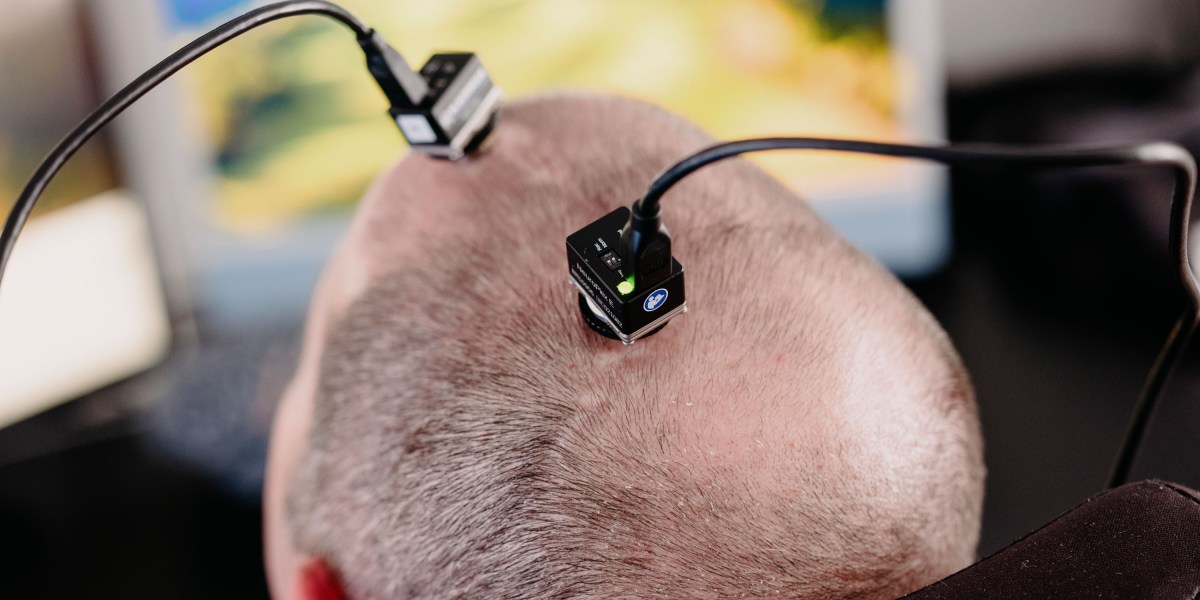
In July 2023, during a five-hour operation, doctors implanted four arrays of 64 electrodes each into his brain. Each pair of arrays was wired to a “pedestal” connection point—creating two docking locations on the exterior of his skull to connect the electrodes to a computer.
The team had long been working on developing algorithms to decode brain activity into speech. Their system works by recording activity from the speech motor cortex—a region of the brain responsible for the movements that allow us to speak.
“There are 39 phonemes that make up all the sounds in the [American] English language,” says Nicholas Card, a neuroengineer at UC Davis and member of the team. Mapping neural activity related to producing each of those phonemes can allow the team to create a personalized speech decoder and software that can “speak” those words. “We first go from brain data to phonemes, and then from phonemes to words,” he says.
They started using the device around a month after the surgery. The team got Harrell’s speech decoder working on the first day, says Card. On that day in August, Harrell used the device to speak with a 50-word vocabulary, and 99.6% of the words were as he’d intended. That vocabulary was later expanded to 125,000 words with 97.5% accuracy.
24World Media does not take any responsibility of the information you see on this page. The content this page contains is from independent third-party content provider. If you have any concerns regarding the content, please free to write us here: contact@24worldmedia.com