

Aerospace NDT Market Trends and Growth Drivers 2032: Advancing Aircraft Inspection and Maintenance

The Aerospace NDT Market Trends landscape is changing rapidly as aircraft manufacturers, airlines, maintenance, repair, and overhaul (MRO) providers, and defense organizations increasingly adopt advanced inspection technologies. Non-destructive testing (NDT) plays a critical role in identifying cracks, corrosion, voids, material inconsistencies, and other defects without damaging aircraft components. As aviation fleets expand and aircraft become more technologically advanced, the demand for accurate, automated, and data-driven inspection solutions is increasing.
According to MarketsandMarkets, The aerospace NDT market is projected to reach USD 5.69 billion by 2032 from USD 3.23 billion in 2026, at a CAGR of 9.9%. Increasing aircraft production and fleet expansion, growing emphasis on aircraft safety and regulatory compliance, adoption of advanced NDT technologies, increasing use of composite materials, and expansion of commercial and defense aviation are among the major factors supporting market growth.
Key Aerospace NDT Market Trends Reshaping Aircraft Inspection
Several technology and industry developments are defining the Aerospace NDT Market Trends and creating new opportunities for equipment manufacturers and inspection service providers. The industry is moving from conventional inspection processes toward connected, automated, and intelligent NDT ecosystems.
AI-enabled defect detection, advanced ultrasonic inspection, digital radiography, robotics, drone-based inspection, cloud-based data management, and predictive maintenance are increasingly influencing aerospace inspection workflows. These technologies can improve inspection accuracy, reduce manual intervention, accelerate testing, and support better aircraft lifecycle management.
The increasing complexity of modern aircraft is also contributing to this transformation. Aircraft manufacturers are adopting lightweight composites, advanced alloys, additive manufacturing, and other innovative materials to improve fuel efficiency and performance. These materials require specialized inspection techniques capable of identifying internal and surface-level defects without affecting component integrity.
Aircraft Fleet Expansion Drives Aerospace NDT Demand
One of the most important factors influencing the Aerospace NDT Market Trends is the expansion of the global aircraft fleet. Rising passenger traffic is encouraging airlines to increase fleet capacity, while defense organizations are investing in new aircraft and upgrading existing platforms.
A larger aircraft fleet creates continuous requirements for inspection, maintenance, certification, and repair. Aging aircraft further increase the need for regular structural inspections because components are exposed to fatigue, corrosion, stress, and environmental conditions throughout their operating lives.
MarketsandMarkets identifies increasing aircraft production and fleet expansion as a key market driver. As more aircraft enter service, NDT solutions become essential throughout the aircraft lifecycle, from manufacturing quality control to scheduled maintenance and MRO operations.
The expansion of MRO infrastructure is therefore closely connected to the growth of the aerospace NDT market. Airlines and aircraft operators are seeking inspection technologies that can minimize aircraft downtime while maintaining stringent safety requirements.
Download PDF Brochure @ https://www.marketsandmarkets.com/pdfdownloadNew.asp?id=234773952
AI and Automation Transform Aerospace NDT
The integration of artificial intelligence (AI) and automation is among the most important Aerospace NDT Market Trends. AI-based inspection systems can analyze large volumes of inspection data and support automated identification of potential defects.
Traditional NDT processes often depend heavily on skilled technicians to interpret inspection results. AI-enabled systems can complement human expertise by highlighting anomalies, improving consistency, and reducing the possibility of overlooking defects.
Automation can also improve inspection speed. Robotic systems can perform repetitive inspection tasks with consistent positioning and scanning, while automated data acquisition can reduce manual documentation requirements.
MarketsandMarkets identifies the integration of AI and automation in NDT as a major opportunity. AI-driven analytics can support faster defect detection and predictive maintenance, while robotics and automated inspection systems can improve scalability and inspection efficiency.
This development is creating a transition toward data-driven aerospace NDT, where inspection results are not simply used to identify existing defects but can also contribute to maintenance planning and aircraft lifecycle optimization.
Advanced Ultrasonic Testing Gains Momentum
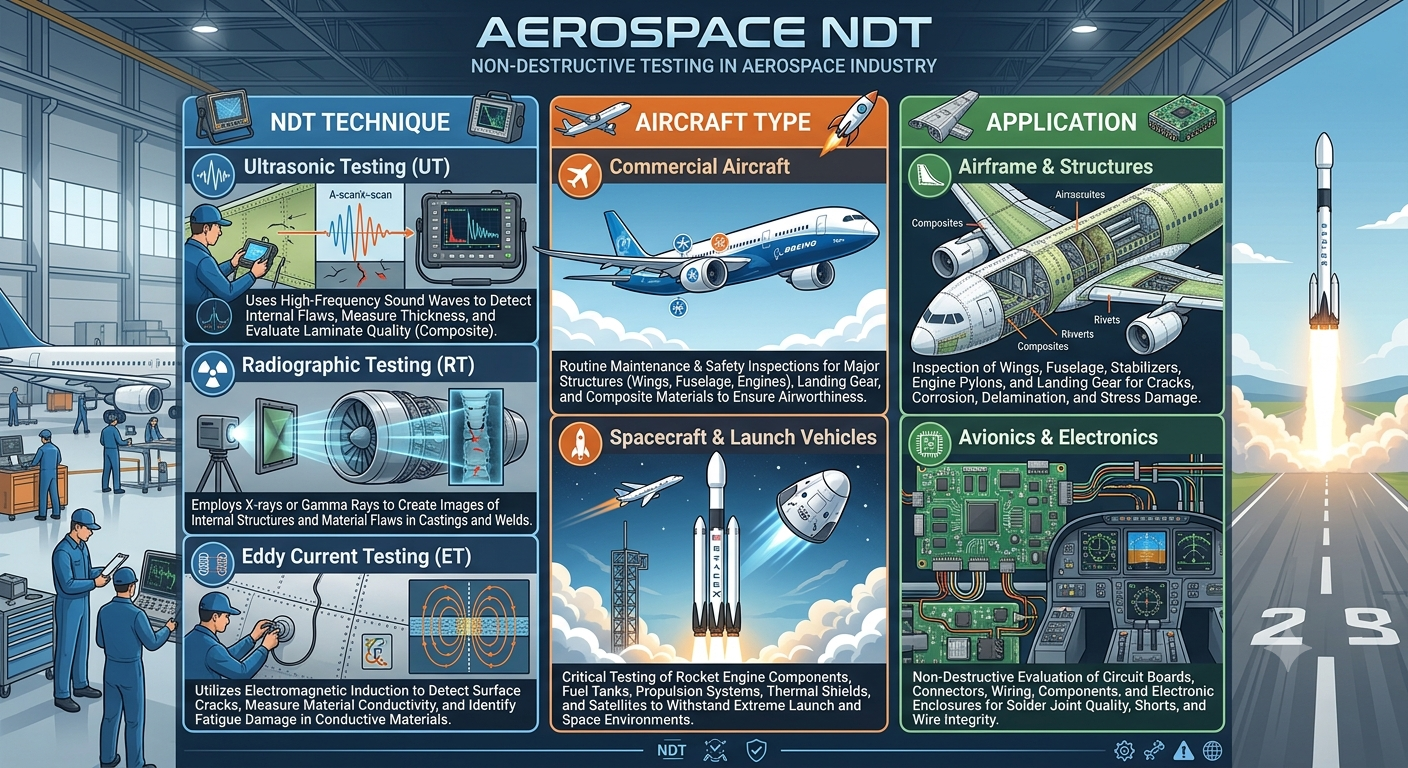
Ultrasonic testing remains one of the most important technologies in the aerospace NDT market. According to MarketsandMarkets, ultrasonic testing leads the market because of its accuracy, deep penetration capability, ability to inspect composite materials, and effectiveness in detecting internal flaws.
One of the emerging Aerospace NDT Market Trends is increasing adoption of advanced ultrasonic techniques such as phased array ultrasonic testing (PAUT). These technologies can provide high-resolution inspection and enable more detailed analysis of complex aerospace components.
Advanced ultrasonic inspection is particularly relevant as aircraft manufacturers increasingly use composite materials and complex structural designs. Inspection systems need to identify internal delamination, voids, cracks, and other defects that may not be visible through conventional visual inspection.
The continued development of ultrasonic systems is expected to create opportunities for equipment manufacturers offering higher-resolution imaging, automated scanning, improved portability, and software-supported analysis.
Digital Radiography Improves Inspection Efficiency
Digital radiography is another technology contributing to changing Aerospace NDT Market Trends. Digital systems can replace or supplement conventional film-based inspection processes and provide faster access to inspection data.
Digital radiography can support improved image management, electronic documentation, and integration with broader digital inspection platforms. When combined with advanced analytics, digital images can also contribute to automated defect identification and more efficient inspection workflows.
MarketsandMarkets highlights the shift toward digital radiography and cloud-based data management as part of the industry’s transition toward more scalable and digitally integrated NDT operations.
For MRO providers and aerospace manufacturers, this transition can help streamline inspection records, improve collaboration, and support better traceability throughout the component lifecycle.
Composite Materials Create New Inspection Requirements
The increasing adoption of lightweight composite materials is another significant factor shaping the Aerospace NDT Market Trends. Aerospace manufacturers use composite materials to reduce weight and improve aircraft fuel efficiency and performance.
However, composite structures can require specialized inspection methods because defects may occur internally and may not always be detectable through conventional inspection approaches.
MarketsandMarkets identifies the growth of composite materials in aircraft as an important growth driver for aerospace NDT. Advanced inspection technologies are increasingly required to evaluate composite structures and identify defects while maintaining the integrity of the components.
This creates opportunities for ultrasonic testing, thermography, digital imaging, and other advanced inspection technologies tailored to composite materials.
Robotics and Drone-Based Inspection Expand Applications
The use of robotics and drones is emerging as another important trend in the aerospace NDT industry. Aircraft structures can be large, complex, and difficult to access, making manual inspection time-consuming and potentially challenging in hazardous or elevated environments.
Robotic inspection systems can provide controlled movement and repeatable scanning, while drones can help inspect difficult-to-access structures. These solutions can reduce the need for extensive manual access equipment and potentially shorten inspection cycles.
MarketsandMarkets highlights increasing use of robotics and drone-based NDT for accessing complex or hazardous structures as a key trend influencing the industry. These technologies can improve inspection speed, accuracy, and worker safety while supporting more efficient maintenance processes.
MRO Expansion Supports Aerospace NDT Market Growth
The expansion of maintenance, repair, and overhaul (MRO) activities is closely linked to the growth of the aerospace NDT market. Aircraft require regular inspections throughout their operating lives, making NDT an essential part of scheduled and unscheduled maintenance.
As global aircraft fleets grow, airlines and aircraft operators need inspection services that can support faster turnaround times while meeting strict regulatory requirements. This is particularly important for commercial aircraft, which represent a major market segment.
MarketsandMarkets reports that services hold the largest share of the aerospace NDT market because inspection, testing, certification, and maintenance activities are required throughout the aircraft lifecycle.
This service-oriented market structure creates opportunities for specialized inspection companies, MRO organizations, and technology providers offering integrated NDT solutions.
Commercial Aircraft Remain a Major Application Area
Commercial aviation continues to represent a significant demand center for aerospace NDT solutions. Large aircraft fleets, increasing passenger traffic, regular maintenance cycles, and stringent safety requirements create recurring inspection needs.
According to MarketsandMarkets, commercial aircraft lead the aerospace NDT market due to large global fleets, frequent maintenance requirements, strict safety regulations, and increasing passenger traffic.
NDT is used across multiple commercial aircraft applications, including airframes and structures, engines and propulsion systems, avionics and electronics, landing gear, mechanical systems, and other critical components.
The increasing complexity of aircraft systems means that inspection providers must support multiple techniques and increasingly sophisticated data-management capabilities.
Airframe and Structural Inspection Leads Demand
Among applications, airframe and structures account for a leading share of the aerospace NDT market. Aircraft structures experience continuous exposure to stress, fatigue, vibration, and environmental conditions, creating a need for regular inspection.
NDT techniques can help identify structural defects before they become more serious problems. Ultrasonic testing, radiographic testing, eddy current testing, magnetic particle testing, liquid penetrant testing, and visual inspection are among the technologies used across aerospace applications.
The increasing use of composites and advanced manufacturing techniques is likely to further increase demand for specialized structural inspection solutions.
Asia Pacific Emerges as a High-Growth Market
Geographic expansion is another important component of the Aerospace NDT Market Trends. MarketsandMarkets expects Asia Pacific to register the highest CAGR of 12.0% during the forecast period.
Aircraft fleet expansion, increasing passenger traffic, rising defense spending, investments in MRO infrastructure, and development of indigenous aerospace manufacturing capabilities are contributing to regional growth.
The emergence of new aerospace hubs across Asia Pacific is also creating opportunities for NDT equipment manufacturers and inspection service providers. As regional airlines expand fleets and governments strengthen aerospace manufacturing capabilities, demand for inspection and certification services is expected to increase.
Challenges Limiting Aerospace NDT Adoption
Despite strong growth prospects, several challenges could influence the adoption of advanced aerospace NDT solutions. One major restraint is the high cost of advanced NDT equipment and implementation.
Technologies such as phased array ultrasonic testing, digital radiography, and automated inspection systems require significant investments. Smaller MRO providers may face budget constraints when implementing advanced systems. Training skilled personnel and integrating new technologies with existing infrastructure can further increase costs.
The rapid pace of technological change is another challenge. Aerospace materials, manufacturing processes, inspection technologies, and regulatory requirements continue to evolve, requiring companies to continuously upgrade equipment and workforce capabilities.
Data management and system integration can also become increasingly complex as inspection operations generate larger quantities of digital information.
Future Outlook for Aerospace NDT Market Trends
The future of the Aerospace NDT Market Trends landscape will be defined by the convergence of AI, automation, advanced imaging, robotics, cloud computing, and predictive maintenance.
The industry is moving toward integrated inspection ecosystems in which equipment, software, analytics, and services work together to provide a comprehensive view of aircraft health. AI-powered inspection platforms could increasingly support automated defect detection, while cloud-based systems can facilitate inspection data management and collaboration.
At the same time, advanced ultrasonic testing, digital radiography, robotics, drone inspection, and technologies designed specifically for composite materials will continue to expand the capabilities of aerospace inspection.
With the global aerospace NDT market projected to grow from USD 2.91 billion in 2025 to USD 5.69 billion by 2032 at a CAGR of 9.9%, the industry is positioned for sustained expansion.
Ultimately, the most important Aerospace NDT Market Trends point toward a shift from periodic, manually intensive inspection toward intelligent, automated, connected, and predictive aircraft maintenance. As aviation organizations prioritize safety, reliability, operational efficiency, and regulatory compliance, advanced NDT technologies will remain an essential part of next-generation aircraft manufacturing and maintenance.
FAQs
1. What are the key Aerospace NDT Market Trends?
Key Aerospace NDT Market Trends include the adoption of AI-powered inspection, automation, advanced ultrasonic testing, digital radiography, robotics, drone-based inspection, and predictive maintenance technologies.
2. What is driving the growth of the Aerospace NDT Market?
The major growth drivers include increasing aircraft production and fleet expansion, rising MRO activities, stringent aircraft safety regulations, growing use of composite materials, and increasing demand for advanced inspection technologies.
3. How is AI transforming aerospace NDT?
AI enables automated defect detection, inspection data analysis, anomaly identification, and predictive maintenance. AI-powered NDT can improve inspection consistency, reduce manual effort, and support faster maintenance decisions.
4. Which NDT technology holds a significant position in the aerospace market?
Ultrasonic testing holds a leading position due to its accuracy, deep penetration capability, and effectiveness in detecting internal defects in aircraft structures and composite materials.
5. Which region is expected to witness the highest growth in the Aerospace NDT Market?
Asia Pacific is expected to register the highest growth, supported by expanding aircraft fleets, increasing passenger traffic, rising defense spending, growing MRO infrastructure, and investments in aerospace manufacturing.
About MarketsandMarkets™
MarketsandMarkets™ is a blue ocean alternative in growth consulting and program management, leveraging a man-machine offering to drive supernormal growth for progressive organizations in the B2B space. We have the widest lens on emerging technologies, making us proficient in co-creating supernormal growth for clients.
The B2B economy is witnessing the emergence of $25 trillion of new revenue streams that are substituting existing revenue streams in this decade alone. We work with clients on growth programs, helping them monetize this $25 trillion opportunity through our service lines – TAM Expansion, Go-to-Market (GTM) Strategy to Execution, Market Share Gain, Account Enablement, and Thought Leadership Marketing.
Built on the ’GIVE Growth’ principle, we work with several Forbes Global 2000 B2B companies – helping them stay relevant in a disruptive ecosystem. Our insights and strategies are molded by our industry experts, cutting-edge AI-powered Market Intelligence Cloud, and years of research. The KnowledgeStore™ (our Market Intelligence Cloud) integrates our research, facilitates an analysis of interconnections through a set of applications, helping clients look at the entire ecosystem and understand the revenue shifts happening in their industry.
To find out more, visit www.MarketsandMarkets™.com or follow us on Twitter, LinkedIn and Facebook.
Contact:
Mr. Rohan Salgarkar
MarketsandMarkets™ INC.
1615 South Congress Ave.
Suite 103
Delray Beach, FL 33445
USA : 1-888-600-6441
24World Media does not take any responsibility of the information you see on this page. The content this page contains is from independent third-party content provider. If you have any concerns regarding the content, please free to write us here: contact@24worldmedia.com