

Data Center Certification Market Growth: AI-Ready Data Centers Accelerate Demand for Certified Infrastructure

The Data Center Certification Market Growth is accelerating as organizations invest in AI-ready infrastructure, hyperscale facilities, cloud computing, colocation data centers, and resilient digital infrastructure. As data centers become increasingly critical to artificial intelligence, cloud services, digital platforms, financial services, healthcare, and industrial applications, operators are placing greater emphasis on infrastructure reliability, cybersecurity, sustainability, energy efficiency, and regulatory compliance.
AI-Ready Infrastructure Accelerates Data Center Certification Market Growth
Artificial intelligence is changing the infrastructure requirements of modern data centers. AI workloads require high-performance computing systems, high-density servers, advanced networking, reliable power infrastructure, and efficient cooling systems. As organizations deploy more GPUs and other accelerated computing technologies, maintaining infrastructure availability and operational resilience becomes increasingly important.
This shift is creating new opportunities for the certification industry. AI-ready data centers need infrastructure capable of supporting higher power densities and demanding thermal loads while maintaining reliable operations. Certification programs can help operators validate infrastructure performance, resilience, compliance, and readiness across different stages of the data center lifecycle.
MarketsandMarkets identifies the growing demand for AI-ready data center certifications as an important opportunity within the market. AI infrastructure deployments are increasing demand for certification programs that assess infrastructure readiness, operational performance, reliability, and compliance with evolving standards.
Top 10 Key Takeaways
- The global Data Center Certification Market is projected to reach USD 3.05 billion by 2032 from USD 1.16 billion in 2026.
- The market is expected to register a 17.4% CAGR from 2026 to 2032.
- AI-ready data center deployments are creating new demand for specialized certification services.
- Hyperscale and colocation data center expansion remains a major driver of certification adoption.
- Facility and reliability certifications are expected to hold the largest certification-type share.
- Information security and cybersecurity certifications are positioned for strong growth as digital infrastructure becomes more connected.
- Power infrastructure is projected to represent approximately 35%–40% of the market in 2032.
- Continuous monitoring and recertification are expected to register the highest growth among certification delivery models.
- Cloud service providers are expected to be a major growth area because of expanding AI-ready cloud infrastructure.
- Sustainability, energy efficiency, cybersecurity, operational resilience, and regulatory compliance will remain important factors shaping the market.
Download PDF Brochure @ https://www.marketsandmarkets.com/pdfdownloadNew.asp?id=37943401
Hyperscale and Colocation Expansion Supports Market Growth
The rapid expansion of hyperscale and colocation data centers is another major contributor to Data Center Certification Market Growth. Cloud service providers, enterprises, and digital infrastructure companies are expanding capacity to accommodate growing workloads generated by cloud applications, AI, analytics, streaming, enterprise software, and connected devices.
Large-scale data center operators require reliable infrastructure that can support continuous operations. Certification can provide independent validation of facility design, infrastructure performance, operational procedures, availability, and resilience.
Hyperscale facilities are expected to account for approximately 55%–60% of the market in 2032, according to MarketsandMarkets. This position is supported by large-scale cloud infrastructure expansion, AI workloads, and the adoption of standardized certification frameworks across global facilities.
Colocation providers are also increasing their focus on certification because customers increasingly require assurances regarding uptime, security, energy performance, and operational reliability. Certified infrastructure can support customer confidence while helping operators demonstrate compliance with applicable requirements.
Facility and Reliability Certification Remains Important
By certification type, facility and reliability certifications are expected to represent the largest share of the Data Center Certification Market. Increasing demand for infrastructure availability, fault tolerance, operational resilience, and reliable facility design is supporting this segment.
Data centers support mission-critical applications where downtime can create operational and financial consequences. Facility and reliability certification therefore helps organizations assess whether infrastructure and operating practices are aligned with established performance and availability requirements.
MarketsandMarkets estimates that facility and reliability certifications could represent approximately 22%–27% of the market in 2032.
At the same time, information security and cybersecurity certifications are expected to experience strong growth. Increasing cyber threats, cloud adoption, regulatory requirements, and AI-enabled infrastructure are increasing the importance of cybersecurity assurance for modern data center environments.
Cybersecurity Becomes a Critical Certification Requirement
Cybersecurity is becoming increasingly integrated into data center infrastructure and operations. Data centers host critical information and computing resources for financial institutions, cloud service providers, government organizations, healthcare companies, manufacturers, and technology companies.
As organizations move workloads to cloud and hybrid environments, they require greater visibility into security controls, governance, access management, business continuity, and operational processes. This is creating additional demand for information security and cybersecurity certifications.
The Data Center Certification Market Growth opportunity therefore extends beyond physical infrastructure. Certification providers are increasingly addressing cybersecurity, information security, business continuity, governance, and compliance requirements alongside traditional facility and operational assessments.
Power Infrastructure Is Central to Certified Data Centers
Power infrastructure is becoming increasingly important as AI and high-performance computing increase data center power requirements. AI-ready facilities can require substantial electrical capacity to support high-density computing environments.
According to MarketsandMarkets, the power infrastructure segment is projected to account for approximately 35%–40% of the Data Center Certification Market in 2032. Demand is supported by investments in resilient electrical infrastructure, redundancy systems, backup power, and high-density AI-ready facilities.
Certification of power infrastructure can address areas such as reliability, redundancy, availability, backup systems, and operational performance. This becomes particularly important for hyperscale and mission-critical facilities where uninterrupted operation is a central requirement.
IT Infrastructure Certification Gains Momentum
The IT infrastructure segment is expected to register the highest CAGR during the forecast period. AI-ready data centers, cloud computing, edge computing, and digital transformation are driving investments in high-performance servers, storage, networking, and cybersecurity systems.
As IT infrastructure becomes more complex, certification requirements are expanding beyond traditional facility-level assessments. Operators increasingly need to demonstrate that critical IT systems can support reliability, performance, security, and compliance objectives.
The growth of AI workloads and hybrid cloud architectures is expected to further increase certification requirements across hyperscale, colocation, and enterprise data centers.
Continuous Monitoring and Recertification Create New Opportunities
One of the most important trends shaping Data Center Certification Market Growth is the move from one-time certification toward continuous monitoring and recertification.
Traditional certification processes may assess infrastructure at specific stages, but data center environments continuously change. IT equipment is upgraded, workloads shift, power systems are modified, cooling requirements evolve, and cybersecurity risks change over time.
Continuous monitoring and recertification help organizations maintain compliance and validate ongoing operational performance. MarketsandMarkets projects the continuous monitoring and recertification segment to register the highest growth during the forecast period.
Digital monitoring technologies, automated compliance tools, analytics, and real-time infrastructure data can further support these services. This creates opportunities for certification providers to develop recurring service models rather than relying solely on periodic certification engagements.
Sustainability and Energy Efficiency Drive Certification Demand
Sustainability has become an important consideration in data center development. Data centers consume significant amounts of electricity and require substantial cooling capacity, making energy efficiency a major operational and environmental consideration.
Organizations are increasingly evaluating power utilization, cooling efficiency, renewable energy integration, environmental performance, and sustainability practices. This is increasing demand for sustainability and energy certifications.
The transition toward more efficient data centers is particularly relevant as AI increases computing density and power requirements. Operators must balance performance with energy efficiency while meeting corporate sustainability objectives and regulatory expectations.
As a result, sustainability certification is becoming an important component of the broader Data Center Certification Market Growth landscape.
Certification Across the Data Center Lifecycle
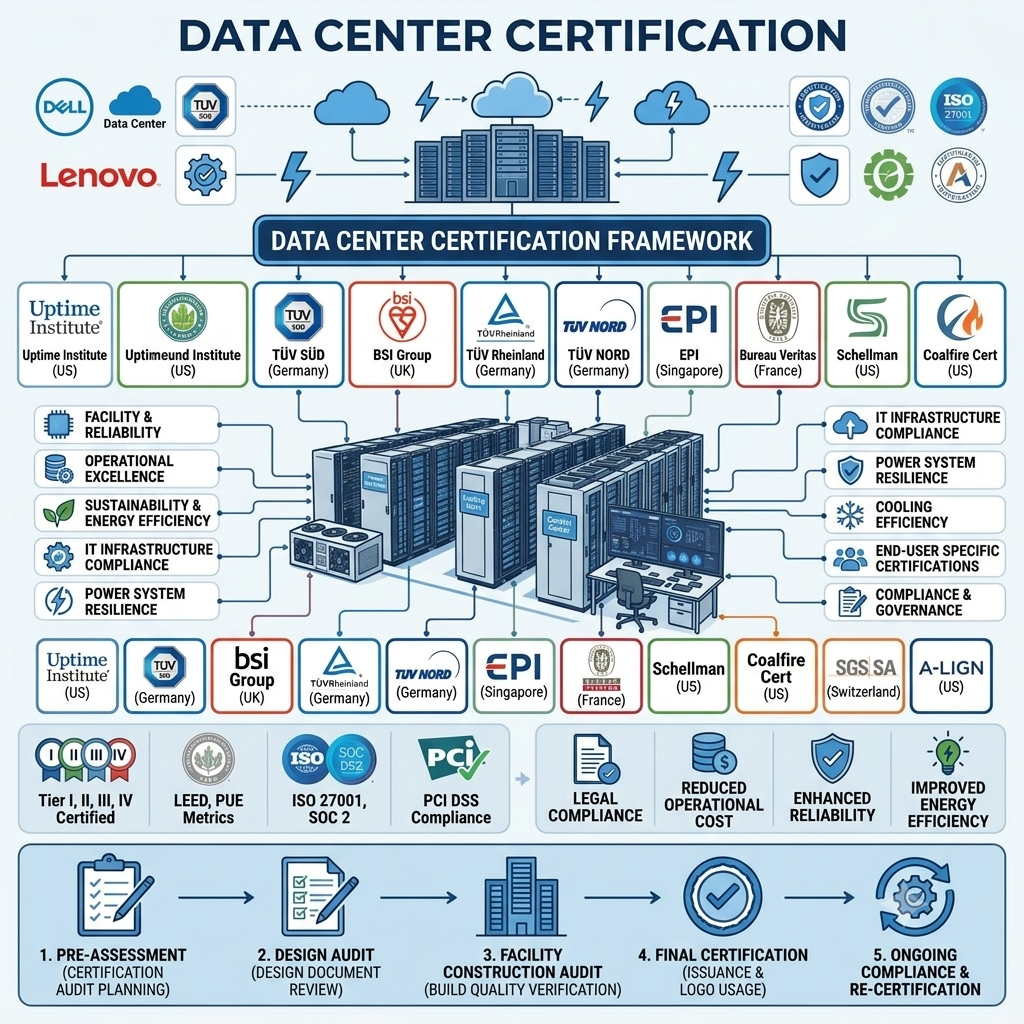
Certification is increasingly being applied across multiple stages of the data center lifecycle. MarketsandMarkets identifies several certification delivery models, including design-phase certification, construction-phase certification, commissioning and integrated validation, operational certification, and continuous monitoring and recertification.
Design-stage certification helps operators evaluate whether planned facilities meet relevant reliability and performance requirements. Construction-stage certification can help validate implementation against approved designs and standards.
Commissioning and integrated validation are important for confirming that different infrastructure systems operate together as expected. Operational certification focuses on ongoing facility performance, procedures, resilience, and compliance.
This lifecycle-based approach creates recurring opportunities for certification providers and supports stronger infrastructure governance from initial planning through long-term operations.
Cloud Service Providers Accelerate Certification Demand
Cloud service providers are expected to register the highest growth among end users during the forecast period. The expansion of AI-ready cloud infrastructure and hyperscale facilities is increasing the need for operational, cybersecurity, sustainability, and reliability certifications.
Cloud providers operate large and geographically distributed infrastructure environments. Certification can help demonstrate that facilities meet established operational and security requirements while supporting customer confidence.
BFSI organizations also represent an important end-user group because financial services depend heavily on secure, resilient, and continuously available digital infrastructure. Manufacturing, telecommunications, healthcare, government, retail, and technology companies are similarly increasing their reliance on data center infrastructure.
North America Maintains a Significant Market Position
North America is projected to account for the largest regional share of the Data Center Certification Market in 2032, at approximately 32%–37%, according to MarketsandMarkets. The region benefits from extensive hyperscale investments, mature digital infrastructure, stringent compliance requirements, and adoption of globally recognized certification frameworks.
The region is also an important market for AI infrastructure deployment. Continued investments in cloud computing, hyperscale facilities, AI computing, and digital infrastructure are expected to support certification requirements.
At the same time, certification demand is expanding globally as organizations in Europe, Asia Pacific, South America, and the Middle East invest in new data center capacity.
Key Challenges Affecting Data Center Certification Market Growth
Despite strong growth opportunities, certification can involve significant costs. Operators may need to invest in audits, documentation, infrastructure improvements, compliance management, and periodic recertification.
MarketsandMarkets identifies the high cost of obtaining and maintaining certifications as a key market restraint. These costs can be particularly relevant for smaller data center operators with limited budgets.
Another challenge is the fragmentation of certification frameworks across regions. Global data center operators may manage facilities subject to different standards, technical requirements, audit methodologies, and regulatory environments.
Maintaining consistent certification practices across multiple countries can therefore increase operational complexity for both data center operators and certification providers.
Technology Innovation Reshapes the Certification Ecosystem
Technology is also changing how certification services are delivered. AI, cloud platforms, digital monitoring, analytics, automation, and connected infrastructure can support more continuous approaches to compliance and infrastructure assessment.
AI-enabled analytics can potentially help identify operational anomalies, while automated monitoring can provide ongoing visibility into power, cooling, IT, and security performance. Digital documentation and centralized compliance platforms can also simplify certification management across geographically distributed facilities.
These technologies support a shift toward data-driven certification models in which infrastructure performance can be assessed more continuously rather than only during periodic audits.
Leading Companies in the Data Center Certification Market
The competitive landscape includes several established certification, testing, inspection, and compliance organizations. Key companies identified by MarketsandMarkets include Uptime Institute, TÜV SÜD, BSI Group, TÜV Rheinland, TÜV NORD, Bureau Veritas, Schellman, Coalfire Systems, SGS SA, and A-LIGN.
These companies compete through globally recognized certification frameworks, expanded accreditation, cybersecurity and sustainability services, operational resilience assessments, and compliance-focused offerings.
As AI-ready data centers become more widespread, providers may increasingly focus on certification services tailored to high-density computing, power resilience, advanced cooling, cybersecurity, sustainability, and continuous operational monitoring.
Future Outlook for Data Center Certification Market Growth
The outlook for Data Center Certification Market Growth remains closely connected to the expansion of AI, cloud computing, hyperscale infrastructure, colocation, and digital transformation.
The market is projected to increase from USD 1.16 billion in 2026 to USD 3.05 billion by 2032, representing a 17.4% CAGR.
AI-ready data centers are expected to remain a major source of opportunity because high-density computing creates additional requirements for reliable power, advanced cooling, infrastructure resilience, cybersecurity, and operational performance.
Meanwhile, continuous monitoring and recertification are expected to become increasingly important as operators seek to maintain compliance throughout the facility lifecycle. Sustainability certifications are also likely to gain importance as organizations address energy consumption and environmental objectives.
Overall, the Data Center Certification Market Growth trajectory reflects the increasing importance of independently validated, resilient, secure, and sustainable digital infrastructure. As data centers evolve into the foundation of AI and cloud-based economies, certification will play an increasingly important role in demonstrating infrastructure reliability, operational readiness, cybersecurity, and compliance.
Frequently Asked Questions
What is the Data Center Certification Market size in 2026?
The Data Center Certification Market is estimated at USD 1.16 billion in 2026, according to MarketsandMarkets.
What will be the Data Center Certification Market size by 2032?
The market is projected to reach USD 3.05 billion by 2032, growing at a CAGR of 17.4% during 2026–2032.
What is driving Data Center Certification Market Growth?
Major factors include hyperscale and colocation expansion, AI-ready data center deployment, cloud computing, digital transformation, cybersecurity requirements, sustainability initiatives, and demand for operational resilience.
Which certification segment is expected to hold the largest share?
Facility and reliability certifications are expected to account for the largest share, supported by demand for infrastructure availability, fault tolerance, and operational resilience.
Which companies are key players in the Data Center Certification Market?
Key companies include Uptime Institute, TÜV SÜD, BSI Group, TÜV Rheinland, TÜV NORD, Bureau Veritas, Schellman, Coalfire Systems, SGS SA, and A-LIGN.
24World Media does not take any responsibility of the information you see on this page. The content this page contains is from independent third-party content provider. If you have any concerns regarding the content, please free to write us here: contact@24worldmedia.com