

Europe Data Center Rack Market Trends 2026

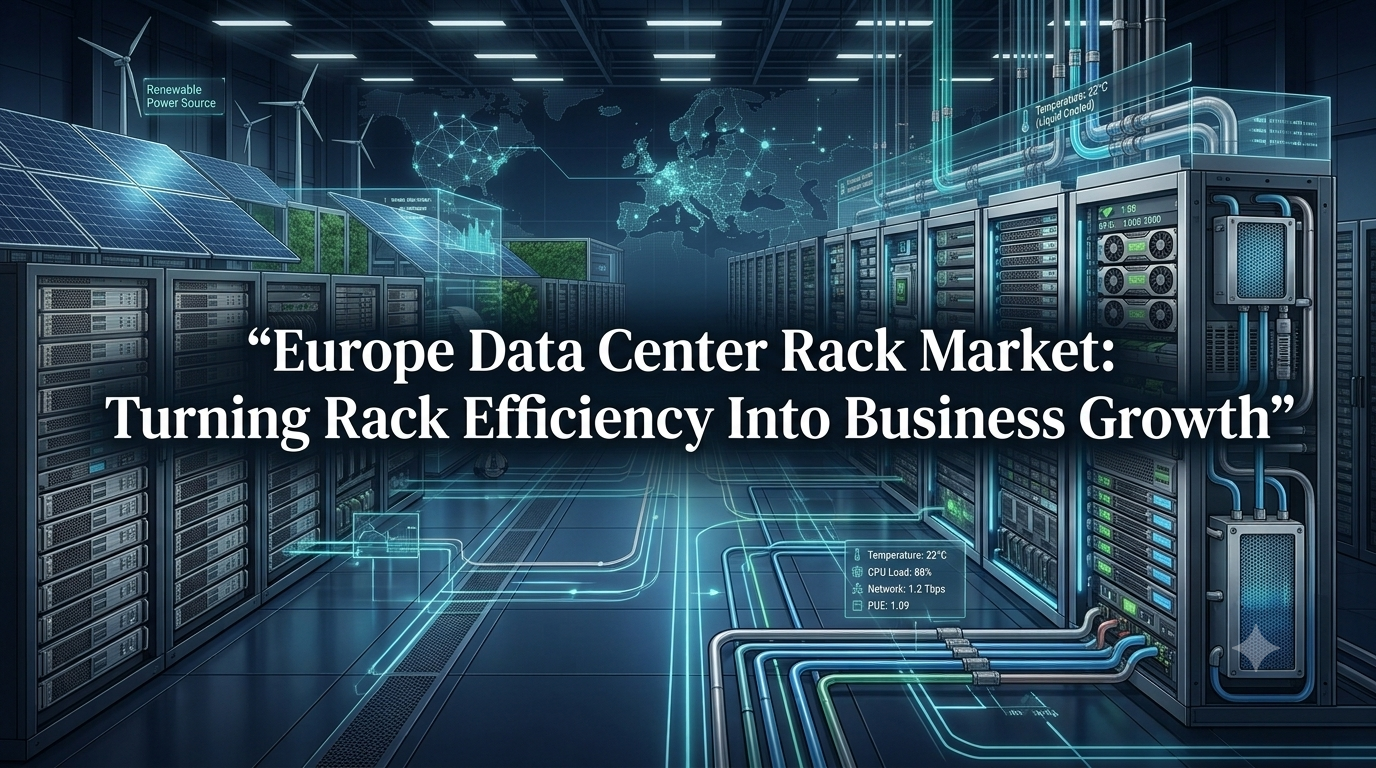
Europe’s data-center infrastructure is reaching an uncomfortable turning point. Energy efficiency is no longer simply a sustainability objective. It is becoming a question of capacity, cost, resilience, and growth. The Europe Data Center Rack Market sits at the center of this shift because the rack has evolved from a passive enclosure into a critical layer for power distribution, thermal management, equipment density, and operational efficiency.
AI is intensifying the challenge. European operators must accommodate rising computing demand while dealing with constrained grid capacity, increasing cooling requirements, and growing expectations for measurable sustainability. The European Commission identifies data centers as an area of increasing energy demand, with environmental considerations including electricity consumption, cooling water, and emissions.
For enterprises, the message is difficult to ignore: a rack that wastes power, limits density, or creates thermal bottlenecks can become a barrier to growth. A smarter rack can become an advantage.
The Rack is no Longer a Cabinet. It is a Business Decision.
- Modern rack procurement increasingly considers power density, cooling, monitoring, scalability, and future workloads.
- European infrastructure constraints are increasing the value of efficient space and power utilization.
- Rack architecture can influence long-term data-center flexibility and expansion.
Traditional rack procurement centered on dimensions, load capacity, equipment compatibility, cable management, and physical security.
Those specifications still matter. But infrastructure leaders are now asking harder questions.
How much power can the rack support? Can it handle high-density AI hardware? Is it liquid-cooling ready? Can operators monitor temperature and power? Can the infrastructure accommodate future equipment without expensive reconstruction?
This is where Europe Data Center Rack Market analysis becomes relevant to enterprise planning.
European data-center expansion is increasingly affected by grid access, planning complexity, and land availability. When new capacity is difficult to secure, organizations need to extract greater value from the infrastructure they already operate.
The rack therefore becomes more than a housing system. It becomes part of the capacity strategy.
Market research indicates strong trends Download the PDF to uncover business insights.
Why Energy Efficiency is Becoming a Boardroom Issue
- Data-center energy demand is closely tied to enterprise digital growth.
- Efficient airflow, power distribution, monitoring, and cooling can improve infrastructure utilization.
- Sustainable rack design increasingly connects environmental goals with operating performance.
Energy efficiency has moved beyond the facilities department because electricity consumption now directly affects digital expansion.
Every new AI application, cloud service, analytics platform, and digital workload requires computing capacity. As that capacity grows, so does the infrastructure required to power and cool it.
A rack can contribute to efficiency through:
- Better airflow management
- Higher equipment density
- Organized cable routing
- Efficient power distribution
- Thermal monitoring
- Advanced cooling compatibility
- Reduced physical footprint
- Modular deployment
These capabilities can help organizations use existing data-center space more effectively while reducing avoidable infrastructure inefficiencies.
That is why Europe Data Center Rack Market trends increasingly overlap with Europe’s wider energy-efficiency and sustainability agenda.
This Sample Report is designed to fuel your business growth download it today.
AI is Breaking the Old Definition of a Sustainable Rack
- AI servers can generate substantially higher power and thermal requirements than conventional enterprise equipment.
- High-density computing is increasing pressure on electrical and cooling infrastructure.
- Sustainable racks must balance density, efficiency, thermal performance, serviceability, and future expansion.
AI is changing the rack equation.
Conventional enterprise workloads could often operate within familiar air-cooled environments. Accelerated computing creates a different infrastructure challenge.
High-performance processors can dramatically increase rack-level power and heat, forcing operators to rethink how computing equipment is housed, powered, cooled, and monitored.
European research initiatives are examining direct liquid cooling, thermal management, adaptive power management, AI workload optimization, and heat reuse as important areas for future data-center efficiency.
This matters for the Europe Data Center Rack Market size because organizations increasingly need to place more computing capability into limited physical footprints.
For enterprises deploying AI, the rack is now part of the AI infrastructure architecture.
A sustainable rack is therefore not simply one manufactured with fewer materials. It must help manage power, heat, density, maintenance, and future expansion.
Liquid Cooling is no Longer a Future Experiment
- Rising rack densities are increasing the relevance of liquid cooling.
- Rack architecture must adapt to changing thermal-management requirements.
- Cooling-ready infrastructure can help organizations prepare for future high-density workloads.
Liquid cooling is moving closer to the center of high-density data-center design.
As AI workloads place greater thermal pressure on conventional air-cooling systems, liquid-based cooling approaches are attracting greater attention. The change affects more than the cooling system itself. It influences rack design, equipment configuration, maintenance, distribution infrastructure, and operational procedures.
For enterprise infrastructure teams, the strategic question is simple: should today’s rack be designed only for today’s server?
A future-ready architecture should provide room for higher-density equipment and emerging cooling technologies. That flexibility can help reduce disruptive retrofits and extend the useful life of infrastructure investments.
Europe’s Power Constraint is Forcing a New Rack Strategy
- Power availability is influencing where data-center capacity can be developed.
- Limited grid capacity increases the importance of computing efficiency.
- Rack-level optimization can help organizations make better use of available power and space.
Power availability has become one of Europe’s defining data-center challenges.
CBRE expects more than 750 MW of additional data-center capacity across Europe in 2026 while highlighting grid limitations and growing interest in alternative power strategies. Colliers has likewise identified power availability as an increasingly important factor in European data-center development.
This creates a direct relationship between Europe Data Center Rack Market growth and energy strategy.
When additional power is difficult to obtain, organizations cannot rely indefinitely on simply adding more infrastructure. They need to improve computing capacity per unit of available power.
Higher-density racks, efficient power distribution, advanced cooling, monitoring, and modular expansion can all help improve infrastructure utilization.
Where Sustainable Racks Can Create Real Enterprise Value
- Enterprise IT can support growing workloads within constrained physical footprints.
- Cloud and colocation providers can benefit from standardized, scalable infrastructure.
- AI, finance, healthcare, manufacturing, and telecom organizations can apply efficient rack architectures to specialized workloads.
The value of sustainable rack infrastructure extends across industries.
Enterprise IT: Higher-density configurations can support growing workloads without proportional increases in physical space.
Cloud and Colocation: Standardized rack architectures can simplify deployments and improve consistency across facilities.
AI Infrastructure: Advanced rack designs can support high-density computing and emerging cooling technologies.
Financial Services: Efficient infrastructure can support analytics and AI workloads while helping manage energy-related operating requirements.
Healthcare: Scalable infrastructure can support increasingly data-intensive applications while maintaining reliability requirements.
Manufacturing: Compact, modular racks can support edge and industrial computing environments.
Telecommunications: Distributed infrastructure can benefit from adaptable rack systems designed for different locations and operating conditions.
This broad application landscape explains why the Europe Data Center Rack Market outlook matters to organizations planning digital infrastructure investments.
The Next Rack Will Be Intelligent, Not Just Strong
- Rack-level sensors can monitor temperature, power, airflow, and equipment conditions.
- DCIM integration can turn rack data into operational intelligence.
- Intelligent monitoring can help operators identify inefficiencies and respond to workload changes.
The next rack revolution will not be defined only by stronger materials or greater physical capacity.
It will be defined by visibility.
Rack-level sensors can provide information about temperature, power consumption, airflow, and equipment conditions. When integrated with DCIM and facility-management platforms, that information can help operators identify inefficiencies and respond to changing operating conditions.
This creates a stronger connection between hardware and software.
The question is no longer simply, “Will the server fit?”
It becomes, “Can this infrastructure deliver measurable performance, efficiency, and scalability?”
That shift is likely to influence the Europe Data Center Rack Market forecast as operators move toward intelligent infrastructure management.
The Business Case is Simple: More Computing, Less Waste
- Efficient rack infrastructure can improve the use of power, space, cooling, and computing capacity.
- Higher density can help organizations maximize expensive data-center footprints.
- Flexible designs can reduce future infrastructure disruption.
Sustainability matters commercially when it improves business performance.
For enterprises, potential benefits include:
- Better utilization of data-center space
- Improved power efficiency
- More predictable thermal performance
- Greater support for AI workloads
- Easier infrastructure expansion
- Reduced need for disruptive redesigns
- Better rack-level visibility
- Stronger sustainability alignment
Europe’s infrastructure environment makes these advantages increasingly relevant. Power constraints, energy requirements, and growing computing demand can influence both operating expenditure and expansion decisions.
AI developers are also examining locations beyond traditional data-center hubs because access to power, land, and utility connections is becoming increasingly important.
The result is a market where infrastructure efficiency can influence where, when, and how digital capacity is deployed.
What Should Enterprises Demand From a Future-Ready Rack?
- Rack selection should reflect expected workloads, not only current server requirements.
- Density, cooling, power, monitoring, modularity, materials, and integration should be evaluated together.
- Infrastructure decisions should match facility design, workload requirements, power availability, and compliance needs.
Enterprise procurement teams should stop evaluating racks only against today’s deployment.
Density: Can the rack support higher-power computing?
Cooling: Can it accommodate emerging liquid-cooling architectures?
Power: Can distribution scale with future workload requirements?
Monitoring: Can operators access actionable rack-level information?
Modularity: Can infrastructure adapt without major reconstruction?
Materials: Does the design support durability and responsible resource use?
Integration: Can the rack connect with DCIM and facility-management platforms?
This makes Europe Data Center Rack Market share and Europe Data Center Rack Market report information useful for understanding market direction and technology developments. However, procurement decisions should ultimately reflect an organization’s workload, facility, power, cooling, operational, and compliance requirements.
Europe’s Next Rack Advantage May Come From Efficiency
- European data-center expansion is increasingly connected to power availability, cooling, sustainability, and infrastructure efficiency.
- Future racks will be evaluated by how effectively they use scarce resources.
- Sustainable rack infrastructure can support scalable, AI-ready enterprise operations.
Europe’s data-center story is changing.
The challenge is no longer simply adding more capacity. It is adding capacity where power is available, where sustainability requirements can be addressed, and where infrastructure can support increasingly demanding workloads.
The future rack will therefore be judged by more than dimensions and load capacity.
Its value will increasingly depend on how effectively it helps an organization use power, space, cooling, computing capacity, and capital.
That is the larger opportunity behind the Europe Data Center Rack Market growth story.
For enterprises, sustainable rack infrastructure can become part of a broader strategy for building AI-ready, energy-efficient, scalable digital operations. For data-center operators, it can support higher-density deployments while helping address the infrastructure constraints shaping Europe’s next generation of facilities.
The Europe Data Center Rack Market forecast ultimately reflects a broader infrastructure shift: efficiency and computing performance are no longer separate ambitions. They increasingly need to work together.
For organizations planning the next phase of digital infrastructure, the strategic question is no longer whether sustainability belongs in rack design. It is how much growth can be lost when efficiency is designed too late.
24World Media does not take any responsibility of the information you see on this page. The content this page contains is from independent third-party content provider. If you have any concerns regarding the content, please free to write us here: contact@24worldmedia.com