

Heads in the game | MIT Technology Review
The MIT Sports Lab’s origin story begins around 2010, when Anette “Peko” Hosoi, the Pappalardo Professor of Mechanical Engineering, fell in love with downhill mountain biking and needed a new bike. But given the varying linkage systems, shock types, and geometries, she found it difficult to choose the best one. Encountering only minimal information online, she assigned the analysis to her 2.001 class, the introductory course on mechanics. “All of my exams that semester were bike questions,” she says. They proved to be really good engineering questions too.
Having recently earned tenure, she wondered, What if I actually built this sports thing into something bigger? In 2011, she began conceptualizing a project called STE@M (Sports Technology and Education at MIT), which would assemble students, faculty, athletes, and industry partners to tackle sports engineering challenges. As the effort kicked into gear over the next few years, Hosoi began collaborating with Christina Chase, MIT’s new entrepreneur in residence, and in 2015 the two of them cofounded the MIT Sports Lab.

COURTESY OF MIT MECHANICAL ENGINEERING
“It turned out that we’re the perfect combination for this because my background comes from the math, physics, engineering side,” says Hosoi. “And she comes from the entrepreneurship [and] product development side. To really interface with these different sports companies and leagues, you need to span that whole spectrum.” Chase became the lab’s managing director and Hosoi its faculty director.
For over a decade, the Sports Lab has grown as interest in sports tech has skyrocketed—and it’s accumulated what younger fans would call some elite ball knowledge in the process.
This depth is exactly what its partners need.
“There’s more and more data that’s getting collected,” says Hosoi. “A lot of the teams, leagues, brands don’t necessarily have the in-house manpower to extract the information they need. So that’s where we can give them a boost.”
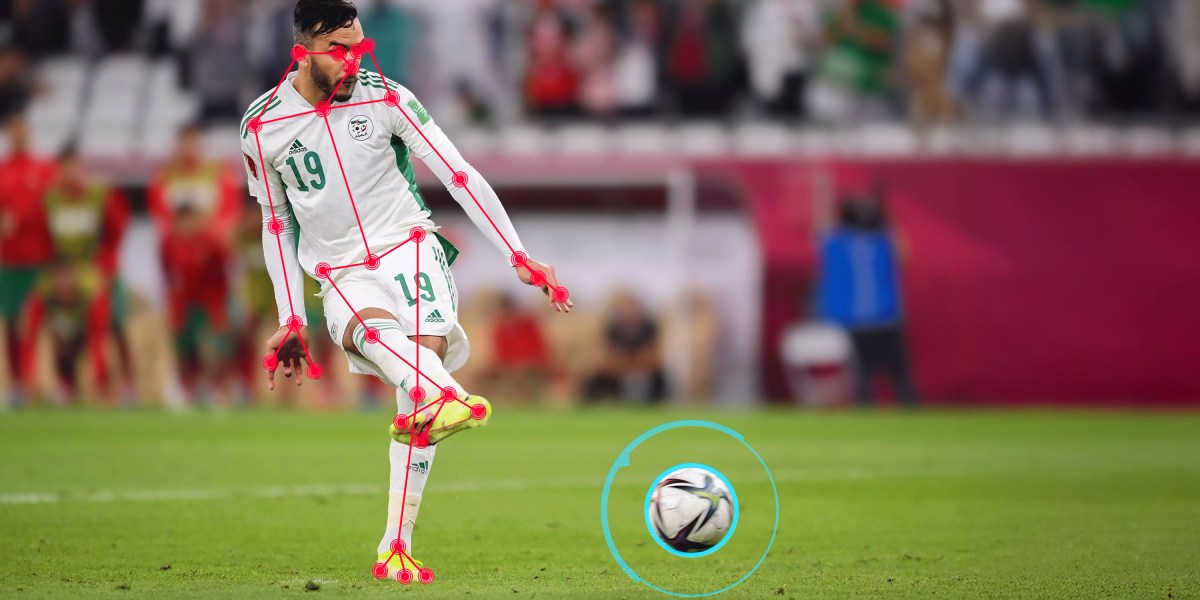
When MIT researchers looked at early skeletal data representing soccer players in motion, they saw “skeletons” flying above the ground or completely underground, in anatomically impossible positions.
The FIFA partnership has been especially fruitful—and the Sports Lab’s role in validating SAOT has probably had more impact than any other project the organizations have worked on together, says Ferran Vidal-Codina, SM ’13, PhD ’17, a former research scientist at the lab who was part of the team from FIFA, MIT, and third-party data providers that developed the technology.
The system’s viability depended on the ability to quickly access and analyze what’s known as tracking data—the record of everywhere the players and the ball move throughout a game.
To collect that information at top-level FIFA tournaments, data providers station about 12 state-of-the-art cameras around the stadium, capturing images at double or more the speed of normal broadcasting cameras. Computer vision algorithms then convert the feeds into what’s called skeletal data—3D representations of the players in motion.
“It’s a ton of data—22 players, one referee, two assistant referees, [each with] 29 joints with XYZ coordinates, 50 times per second,” says Henry Wang ’23, a former MIT varsity swimmer who earned undergrad degrees in both business analytics and computer science, economics, and data science and is now a Sloan PhD candidate and a FIFA research consultant at the MIT Sports Lab.
24World Media does not take any responsibility of the information you see on this page. The content this page contains is from independent third-party content provider. If you have any concerns regarding the content, please free to write us here: contact@24worldmedia.com