

Position Sensor Market: Emerging Technologies, Innovation Trends, and Growth Opportunities Through 2032

The position sensor market is projected to grow from USD 14.53 billion in 2026 to USD 23.40 billion by 2032, at a CAGR of 8.3% during the forecast period.
The position sensor market is witnessing continuous technological advancements, driven by the increasing need for accurate, reliable, and real-time position measurements across automotive, industrial automation, robotics, aerospace & defense, healthcare, and electronics applications. Manufacturers are developing advanced position-sensing solutions based on magnetic, inductive, optical, capacitive, ultrasonic, and 3D technologies to improve measurement accuracy, response time, durability, and system integration. The integration of position sensors with digital interfaces, IoT platforms, automation systems, and intelligent control technologies is enabling real-time monitoring, precise motion control, and predictive maintenance. In parallel, advancements in non-contact sensing, miniaturization, high-resolution measurement, and smart sensor technologies are expanding the technology’s suitability for EVs, ADAS, robotic systems, machine tools, actuators, and automated production equipment.
Download PDF Brochure @ https://www.marketsandmarkets.com/pdfdownloadNew.asp?id=17719728
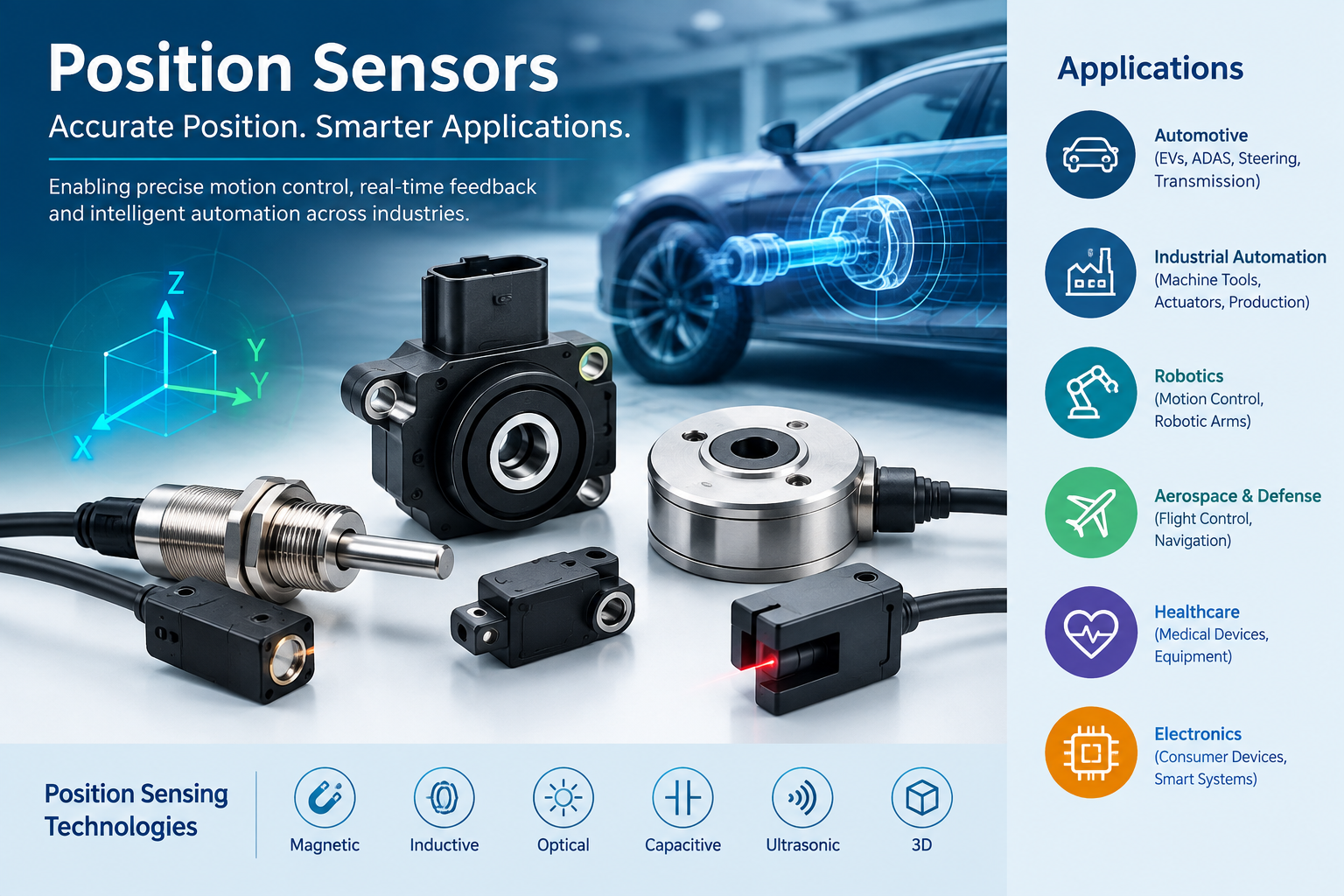
The growing adoption of Industry 4.0, electric vehicles, robotics, and smart manufacturing is further supporting demand for advanced position sensors. Non-contact sensing, digital signal output, and reliable wired connectivity are increasingly important for applications requiring high accuracy, interference resistance, and continuous operation. Consequently, ongoing product innovation, greater integration with automated systems, improvements in sensing performance and durability, and expanding deployment across automotive and industrial applications are contributing to a dynamic and increasingly competitive global position sensor market.
By country, the US represents a significant share of the North American market for position sensors, supported by strong demand from automotive, industrial automation, aerospace & defense, healthcare, and advanced manufacturing sectors. Demand is increasing across applications such as EVs, ADAS, robotics, machine tools, automated production systems, and precision equipment, where accurate and reliable position measurement is essential. The growing adoption of position sensors in vehicle steering, braking, transmission, motors, actuators, and battery systems is supporting market expansion. Furthermore, the integration of magnetic, inductive, optical, 3D, and non-contact sensing technologies with digital interfaces and automated control systems is creating new opportunities by improving accuracy, real-time feedback, reliability, and system integration. Continued investments in industrial automation, robotics, EVs, smart manufacturing, aerospace systems, and connected technologies are expected to further strengthen the US position in the North American market.
By type, the 3D sensor segment is expected to register the highest CAGR in the position sensor market, driven by increasing demand for multidimensional position measurement across automotive, industrial automation, robotics, and consumer applications. 3D position sensors can detect magnetic-field changes across the X, Y, and Z axes, enabling linear, angular, and rotational position measurement with high accuracy and compact form factors. These capabilities make 3D sensors particularly suitable for EV systems, steering and gear-position detection, robotic controls, joysticks, actuators, and advanced human-machine interfaces. Additionally, the adoption of 3D Hall-effect sensors with digital interfaces, stray-field compensation, low-power operation, and functional-safety features is expanding their suitability for demanding automotive and industrial applications. As manufacturers continue to improve sensing accuracy, miniaturization, connectivity, and system integration, the 3D sensor segment is expected to gain traction and contribute significantly to the growth of the position sensor market.
By contact type, the non-contact segment is expected to account for a significant share of the position sensor market, supported by growing demand for position-sensing solutions that can measure movement without mechanical contact and associated wear. Non-contact position sensors, primarily based on magnetic, inductive, optical, and capacitive technologies, can provide accurate linear, angular, and rotary position measurement while improving durability and operational reliability. These sensors are widely used in automotive systems, industrial automation, robotics, aerospace, medical equipment, and other applications requiring continuous and precise motion feedback. Non-contact position sensors are particularly attractive for applications where long service life, reduced maintenance, high accuracy, and resistance to vibration, dust, moisture, and harsh operating conditions are important. Magnetic and inductive sensors can provide reliable sensing without physical contact, while optical technologies support high-resolution position measurement. This eliminates mechanical wear associated with contacting sensors and supports longer operating life, reliable performance, and simplified maintenance across demanding applications.
For more info: https://www.marketsandmarkets.com/Market-Reports/position-sensor-market-17719728.html
24World Media does not take any responsibility of the information you see on this page. The content this page contains is from independent third-party content provider. If you have any concerns regarding the content, please free to write us here: contact@24worldmedia.com