

US Data Center Colocation Market: Hybrid Cloud Edge
Infrastructure Has Evolved into a Strategic Business Asset
The US Data Center Colocation Market is witnessing robust expansion as organizations reimagine their infrastructure strategies to support cloud transformation, artificial intelligence adoption, cybersecurity modernization, and digital business growth. Today’s enterprises require infrastructure ecosystems that simultaneously deliver scalability, flexibility, security, performance, and operational excellence.
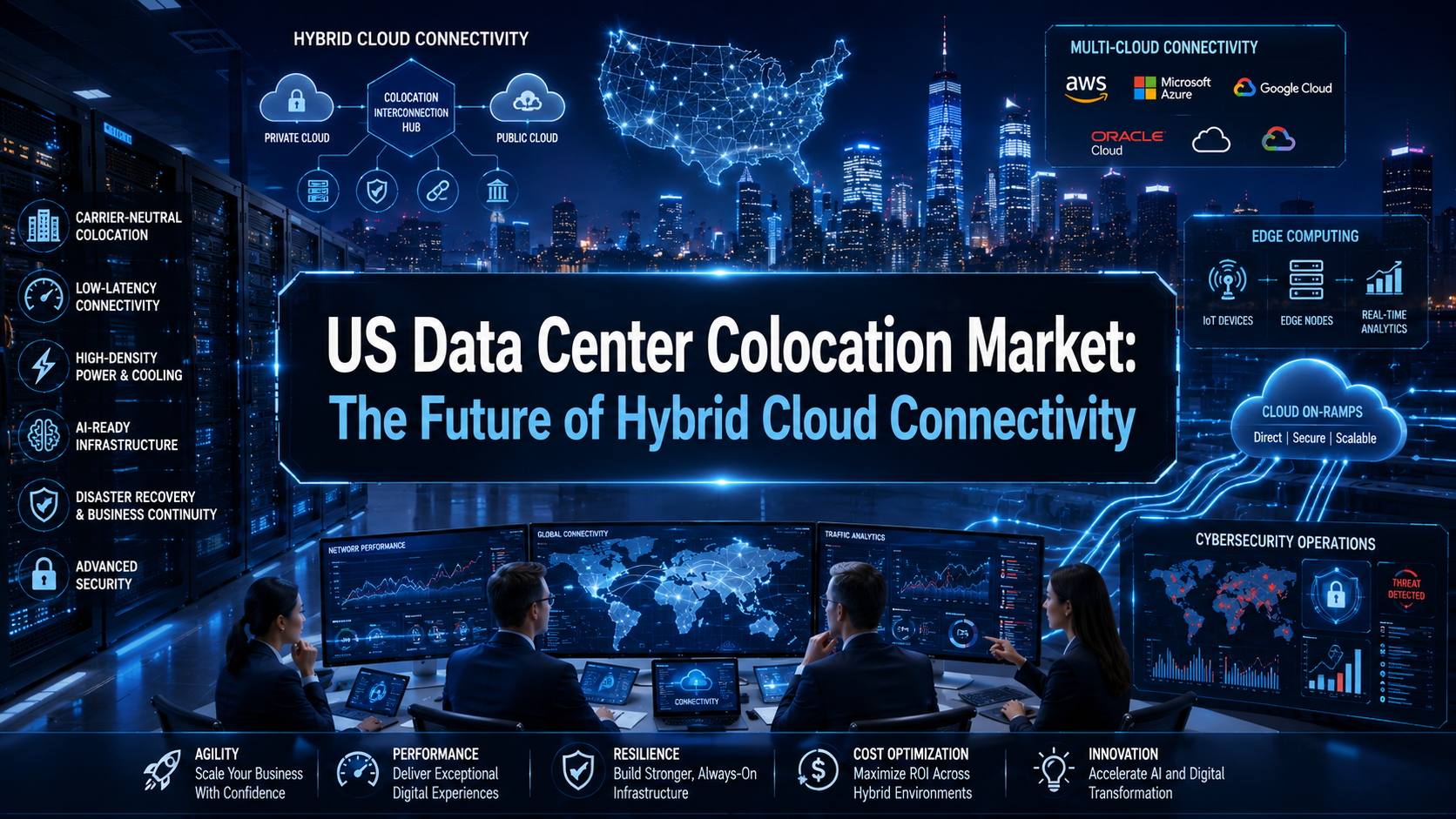
In this environment, Hybrid Cloud Connectivity has emerged as a critical architectural framework that seamlessly integrates public cloud platforms, private environments, edge computing infrastructure, and business-critical applications. Rather than viewing on-premises and cloud environments as competing options, forward-looking organizations are leveraging colocation facilities as strategic interconnection hubs that facilitate workload mobility, business continuity, and operational resilience.
As digital ecosystems become increasingly complex and interconnected, Hybrid Cloud Connectivity is rapidly evolving from an IT initiative into a core business enabler that drives innovation, agility, and sustainable growth.
The Transformation of Enterprise Infrastructure
Over the past decade, enterprise infrastructure has undergone a fundamental shift from centralized data center environments to highly distributed and interconnected digital ecosystems.
Modern enterprise architectures increasingly encompass:
- Public cloud platforms
- Private cloud environments
- Edge computing deployments
- Software-defined networking solutions
- AI-enabled infrastructure
- Carrier-neutral colocation facilities
This transformation reflects growing business demands for agility, scalability, operational resilience, and continuous innovation. Infrastructure decisions now directly influence customer experiences, revenue generation, business continuity, and competitive differentiation.
Market research indicates strong trends Download the PDF to uncover business insights.
Why Hybrid Cloud Connectivity Is Becoming Essential
Modern enterprises rarely operate within a single technology environment. Business-critical applications, data repositories, and digital services are often distributed across multiple cloud platforms, private infrastructure, SaaS ecosystems, and edge locations.
Hybrid Cloud Connectivity enables organizations to:
- Establish secure cloud-to-cloud communications
- Minimize network latency
- Enhance application performance
- Optimize infrastructure expenditures
- Strengthen disaster recovery capabilities
- Enable seamless workload portability
As a result, Hybrid Cloud Connectivity has become a foundational pillar of enterprise digital transformation strategies across industries.
Emerging Technology Trends Shaping Enterprise Infrastructure
Several technology developments are accelerating investments in Hybrid Cloud Connectivity and colocation services.
Artificial Intelligence Infrastructure
The rapid growth of AI applications requires high-performance computing environments, low-latency connectivity, and substantial processing capacity capable of supporting data-intensive workloads.
Multi-Cloud Adoption
Organizations are increasingly deploying workloads across multiple cloud providers to improve operational flexibility, optimize costs, and reduce vendor dependency.
Edge Computing Expansion
Real-time applications require infrastructure positioned closer to users, devices, and operational environments to support low-latency performance.
Data Sovereignty and Governance
Organizations must maintain greater control over sensitive information while ensuring compliance with evolving regulatory requirements across global markets.
Sustainable IT Strategies
Energy efficiency and environmental sustainability have become strategic priorities as enterprises seek to reduce operational costs and support ESG initiatives.
Collectively, these developments continue to influence evolving US Data Center Colocation Trends across the enterprise technology landscape.
Discover what’s fuelling successful companies download the Sample Report for your business growth.
The Expanding Strategic Value of Colocation Facilities
Modern colocation facilities have evolved significantly beyond traditional space and power offerings.
Today’s leading providers deliver:
As a result, colocation facilities now function as sophisticated digital interconnection ecosystems where organizations can seamlessly connect applications, cloud environments, business partners, and end users.
US Data Center Colocation Market: Current Business Landscape
The United States continues to lead the global colocation industry, supported by strong enterprise demand for interconnected, scalable, and secure infrastructure environments.
Several factors are driving sustained market adoption:
- Enterprise cloud modernization initiatives
- Growing investments in AI infrastructure
- Rising cybersecurity concerns
- Increasing volumes of digital transactions
- Business continuity and resilience requirements
- Expansion of edge computing deployments
Recent US Data Center Colocation Analysis indicates that organizations increasingly regard colocation as a strategic technology investment rather than a traditional facilities management solution.
The expanding US Data Center Colocation Size further reflects growing enterprise demand for flexible infrastructure ecosystems capable of supporting future growth initiatives.
Enterprise Applications Across Industries
Financial Services
Key Applications
- High-frequency transaction processing
- Trading infrastructure platforms
- Fraud detection and analytics systems
- Disaster recovery environments
Business Benefits
- Lower transaction latency
- Enhanced security controls
- Improved regulatory compliance
Healthcare
Key Applications
- Electronic health record hosting
- Telemedicine platforms
- Medical imaging repositories
- Advanced analytics environments
Business Benefits
- Enhanced patient experiences
- Stronger data protection
- Greater operational efficiency
Retail and E-Commerce
Key Applications
- Omnichannel commerce platforms
- Secure payment processing systems
- Customer intelligence platforms
- Inventory optimization solutions
Business Benefits
- Faster transaction processing
- Improved customer satisfaction
- Greater business scalability
Manufacturing
Key Applications
- Industrial IoT ecosystems
- Predictive maintenance platforms
- Smart factory infrastructure
- Supply chain analytics solutions
Business Benefits
- Reduced operational downtime
- Increased productivity
- Enhanced operational visibility
Technology and SaaS Providers
Key Applications
- Cloud-native application environments
- Software delivery networks
- AI service platforms
- Global application deployment infrastructure
Business Benefits
- Accelerated market expansion
- Enhanced application performance
- Improved scalability
The increasing adoption of these use cases continues to strengthen overall US Data Center Colocation Share within enterprise infrastructure investment portfolios.
Business Advantages of Hybrid Cloud Connectivity
Organizations implementing Hybrid Cloud Connectivity strategies gain substantial operational and strategic value.
Enhanced Business Agility
Infrastructure resources can be deployed and scaled based on evolving business requirements.
Improved Application Performance
Optimized connectivity and lower latency contribute to superior user experiences and operational efficiency.
Greater Operational Resilience
Distributed architectures reduce the risk of service disruptions and strengthen business continuity.
Cost Optimization
Organizations can strategically position workloads based on performance, compliance, and economic considerations.
Accelerated Innovation
Development teams gain access to scalable infrastructure environments that support rapid experimentation and innovation.
These benefits are consistently highlighted in leading US Data Center Colocation Report findings.
AI, Edge Computing, and the Next Era of Connectivity
Artificial Intelligence is emerging as one of the most significant growth drivers for colocation services.
AI environments require:
- High-density power infrastructure
- Extensive data throughput capabilities
- Low-latency networking
- Highly scalable computing resources
Similarly, edge computing continues to expand as organizations deploy real-time applications across diverse environments.
Examples include:
- Autonomous systems
- Smart manufacturing operations
- Connected healthcare platforms
- Intelligent retail ecosystems
- Industrial automation solutions
Together, AI and edge computing are creating substantial opportunities for continued US Data Center Colocation Growth.
Security, Compliance, and Risk Management
As infrastructure architectures become increasingly distributed, maintaining effective governance and security controls becomes essential.
Key priorities include:
- Zero-trust security frameworks
- End-to-end encryption
- Continuous monitoring and threat detection
- Identity and access management
- Regulatory compliance management
- Disaster recovery planning
Colocation providers play an increasingly important role in helping organizations address these requirements effectively.
Key Challenges Organizations Must Address
Despite the substantial advantages of Hybrid Cloud Connectivity, enterprises must overcome several challenges.
Infrastructure Complexity
Managing distributed hybrid environments requires specialized expertise and sophisticated operational frameworks.
Cost Governance
Organizations need comprehensive visibility into connectivity, cloud, and infrastructure expenditures.
Capacity Planning
AI-driven workloads continue to increase demands for power, cooling, and networking resources.
Talent and Skills Availability
Hybrid cloud environments require multidisciplinary expertise spanning networking, cloud operations, cybersecurity, and infrastructure management.
Organizations that successfully address these challenges will be better positioned to capitalize on future opportunities.
Future Outlook for the US Data Center Colocation Market
The future of enterprise infrastructure will be defined by greater connectivity, intelligence, and automation.
Key developments expected to shape the next decade include:
- AI-native data center architectures
- Expanded edge computing ecosystems
- Enhanced cloud interconnectivity
- Autonomous infrastructure operations
- Sustainable data center initiatives
- Quantum-resilient security frameworks
The overall US Data Center Colocation Outlook remains highly favorable as enterprises continue investing in digital transformation, cloud modernization, and AI-enabled business models.
Industry analysts anticipate strong US Data Center Colocation Forecast momentum driven by cloud adoption, artificial intelligence investments, and increasing demand for resilient digital infrastructure.
Strategic Priorities for Technology Leaders
To maximize long-term business value, CIOs and technology executives should focus on:
- Developing enterprise-wide Hybrid Cloud Connectivity strategies
- Investing in AI-ready infrastructure environments
- Strengthening disaster recovery and resilience capabilities
- Enhancing cybersecurity and compliance frameworks
- Leveraging colocation facilities as strategic interconnection platforms
- Aligning infrastructure investments with broader business objectives
Organizations that embrace these priorities will be better positioned to achieve sustainable growth, operational efficiency, and competitive differentiation.
Hybrid Cloud Connectivity is rapidly becoming the backbone of modern enterprise infrastructure. As organizations seek to balance innovation, performance, security, resilience, and cost optimization, colocation facilities provide the digital foundation necessary to support increasingly complex business operations.
The continued expansion of the US Data Center Colocation Market, supported by rising US Data Center Colocation Size, accelerating US Data Center Colocation Growth, evolving US Data Center Colocation Trends, comprehensive US Data Center Colocation Analysis, favorable US Data Center Colocation Outlook, and strong US Data Center Colocation Forecast, underscores a broader industry transformation. Colocation has evolved far beyond traditional infrastructure services and now serves as a strategic platform that enables enterprise agility, AI readiness, operational resilience, and long-term business success in the digital economy.

24World Media does not take any responsibility of the information you see on this page. The content this page contains is from independent third-party content provider. If you have any concerns regarding the content, please free to write us here: contact@24worldmedia.com