

NASA is building the first nuclear reactor-powered interplanetary spacecraft. How will it work?
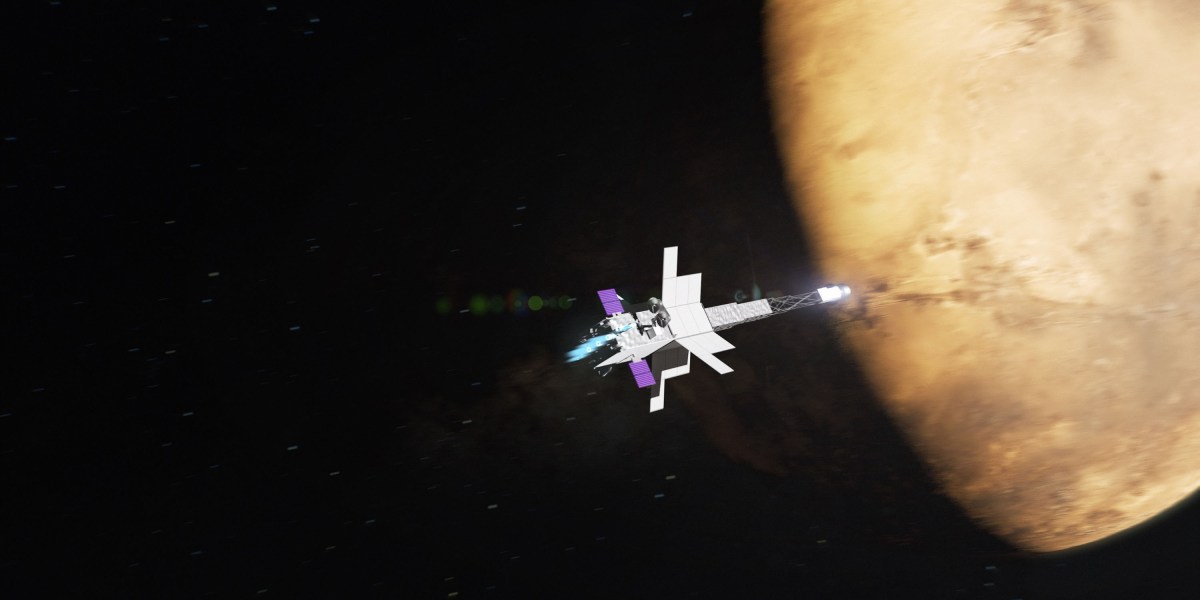
What might the SR-1 look like? MIT Technology Review saw a presentation by Steve Sinacore, program executive of NASA’s Space Reactor Office, that offers some clues. So far, the concept art makes it look like a colossal fletched arrow. At the back will be the power-and-propulsion system, while its tip will hold a 20-kilowatt-or-greater uranium-filled nuclear reactor. (For context, a typical nuclear plant on Earth is 50,000 times more powerful, producing a gigawatt of power.)

NASA
The “fletches” on SR-1 are large fins that allow the reactor to cool down. “You have to have really large radiators,” says Holmes, since the nuclear fission process produces so much heat that much of it has to be vented into space—otherwise, the reactor and spacecraft will melt.
According to that presentation, the spacecraft’s hardware development is due to start this June. By January 2028, SR-1’s systems should be ready for assembly and testing. And by that October, the spacecraft will arrive at the launch site, ready for liftoff before the year’s end. Will the nuclear reactor manage to hold itself together? “Going through the launch safely is going to be a challenge,” says Middleburgh. “You are being shaken, rattled, and rolled.”
Then, he says, “once you’re up in space, once you’ve got through that few minutes of hell in getting there, it’s zero-gravity considerations you have to worry about.” The question then becomes: Will the mechanics of the reactor, built on terra firma, still work?
For safety reasons, the nuclear reactor will be switched on around two days post-launch, when it’s comfortably in space. Uranium isn’t tremendously dangerous by itself, but that can’t be said of the nuclear waste products that emerge when the reactor is activated, so you don’t want any of that to fall back to Earth.
If this schedule is adhered to, and SR-1 works as planned, it’s expected to reach Mars about a year after launch. “It’s an aggressive timeline,” says Holmes, something she suspects is being driven partly by China’s and Russia’s own deep-space nuclear ambitions. The two countries aim to place their own nuclear reactor on the moon’s surface to power the planned International Lunar Research Station—a jointly operated lunar base—by 2035.
Whether it flies or fails in space, SR-1’s operations should help NASA with putting a nuclear reactor on the moon soon after. “All of the things we’d be learning about how that system operates in space [are] very helpful for a surface application, because basically it’s the same,” says Corbisiero. “There’s still no air on the moon.”
And if SR-1 does triumph, it will be a game-changing victory for NASA. It will also be “a massive win for the human race, frankly,” says Middleburgh. “It will be a marvel of engineering, and it will move the dial in humans potentially taking a step on Mars.” Like many of his colleagues, including Holmes, he remains thrilled by the prospect of the first-ever nuclear-powered interplanetary spacecraft—even with the incredibly ambitious timeline.
“These are the things that get us up in the morning,” he says. “These are the sorts of things we will remember when we’re old.”
24World Media does not take any responsibility of the information you see on this page. The content this page contains is from independent third-party content provider. If you have any concerns regarding the content, please free to write us here: contact@24worldmedia.com